CUBA, Life and Death Under Trump’s Oil Blockade
This text reflects the views of its authors and is part of a series of testimonies gathered during the Nuestra América Convoy to Cuba, organized by Global Exchange, a partner of Terra 360. It was originally published on March 26 here: https://globalexchange.org/life-and-death-under-trumps-oil-blockade/
Pharmacy shelves lie bare. Streets darken. Refrigerators sweating as the power fails once again. Doctors counting doses. Families counting meals. This is what the U.S. blockade looks like in Cuba. It is the daily struggle to keep life going.
We leave Cuba changed. Not because we did not expect hardship, but because of its scale, and because of the quiet endurance of a people, of a community, of a nation required to live within these conditions year after year.
What we witnessed here cannot be captured in headlines or statistics.
It is etched into daily life across the island: into the long lines for transportation that never arrive, into homes that go dark without warning, into cancer patients waiting for treatment that has been delayed, and into the question many carry: Is this the worst, or is the worst yet to come?
U.S. President Donald Trump and Secretary of State Marco Rubio have made clear their intention to pursue regime change in Cuba.
For over three months, no fuel has been allowed to reach the island.
Not a drop
The United States oil blockade is driving Cuba toward a humanitarian crisis. The most vulnerable — newborns, the elderly, and the sick — are at the greatest risk. What is debated in distant, cold political language is lived here as daily deprivation.
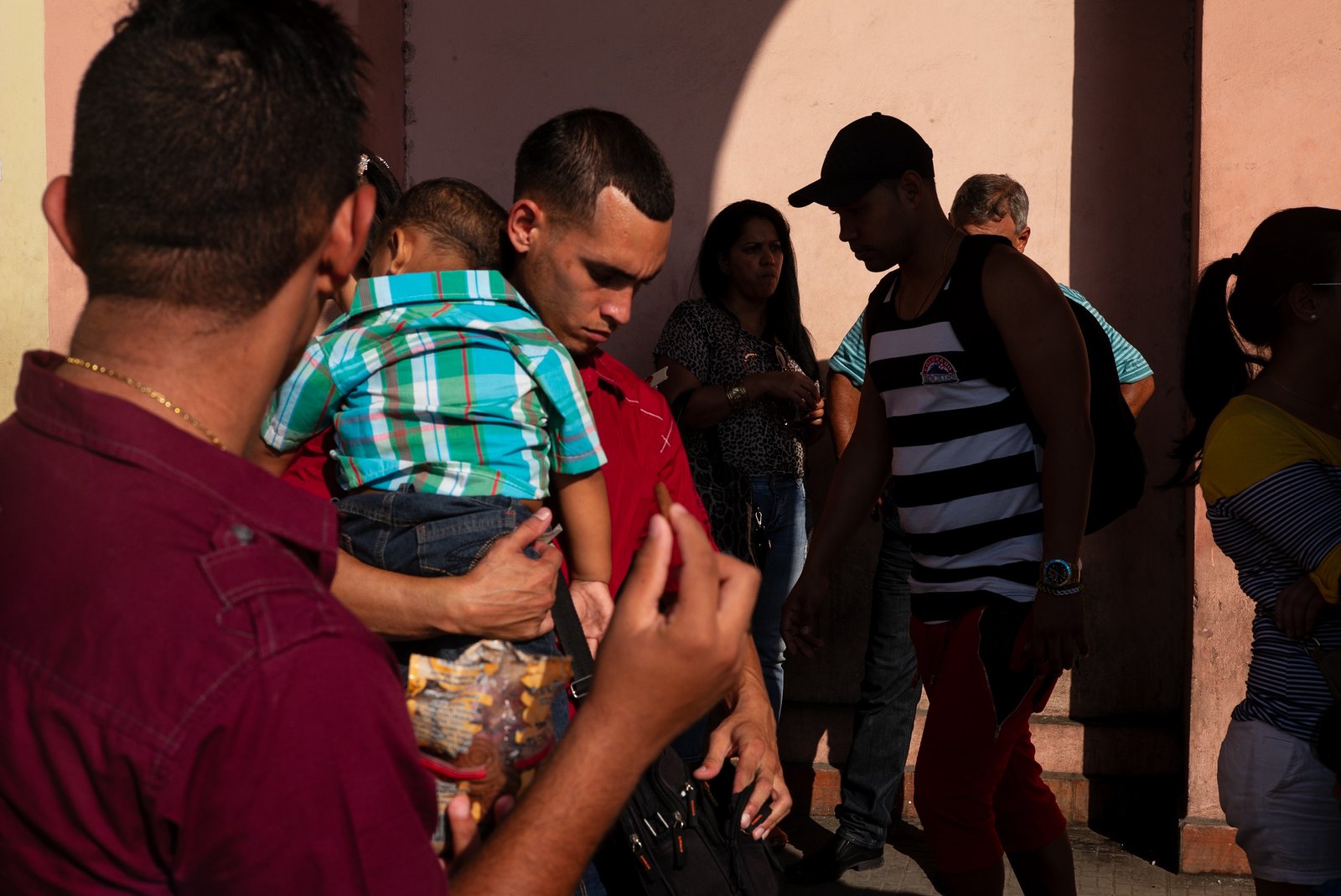
It is difficult to convey what that means unless you see it firsthand. The stillness of streets once filled with buses, the darkened neighborhoods when electricity falters, the palpable fatigue in the faces of people who have adapted again and again to scarcity that is neither natural nor inevitable.
And yet, even in the midst of profound exhaustion, life continues. Communities organize. Teachers return to their classrooms. Doctors keep working, caring for the sick. Neighbors share what little they have. The resilience of the Cuban people is steady, daily, and collective. Even in the face of the most egregious acts of violence, Cubans remain committed to life, dignity, and self-determination.
This visit to Cuba has made silence impossible.
Global Exchange traveled to Cuba as part of the Nuestra América Convoy, a coordinated international effort that brought together hundreds of people from across the United States, Latin America, Europe, and beyond in a collective act of solidarity. Communities organized, gathered supplies, and joined hands to deliver urgently needed humanitarian aid during a period of severe shortages. As part of this effort, Global Exchange carried more than $23,000 worth of life-saving cancer medicines and approximately 1,700 pounds of humanitarian aid, contributing to the convoy’s delivery of more than 20 tons of supplies to communities across the island.
When Fuel Disappears, Everything Slows. Then Stops.
At first glance, cutting off oil to Cuba may look like a pen pressed to paper in a quiet office, a decision made under bright lights, far from the darkened streets it will leave behind. On the ground, it reshapes daily life in the most fundamental ways.
Cuba stretches nearly 800 miles across the Caribbean, just 90 miles from the shores of the United States. The country can refine oil, but it does not have its own supply of crude. Like most nations, its basic infrastructure depends on fuel for transportation, electricity, water systems, agriculture, and healthcare.
Cuba’s last shipment of oil arrived on January 9. Since then, the country has been forced to operate with dwindling reserves.
When fuel disappears,
Cars and trucks remain idle.
Ambulances remain parked because there is no fuel.
Food cannot be transported from farms to markets.
Electrical grids falter, and when electricity fails, so, too, do water systems.
Hospitals are canceling surgeries and sending patients home because doctors and nurses can’t commute to work.
The effects ripple outward through every layer of society.
Daily life begins to falter. Slowly at first, then a rapid collapse.
This is the cruel intention of the United States’ fuel blockade.
Its impact is measured in human lives.
Its target is the Cuban people.
In recent weeks, the consequences have become horrific. Entire sections of Havana have gone permanently dark. On some nights, the power fails across the entire nation. We were there during one of the blackouts. On Saturday, Cuba’s power grid collapsed, leaving the country without electricity for the third time in March. The streets fell silent. Businesses closed their doors. Cell phones stopped working, and the internet disappeared. Entire neighborhoods went dark. At our casa, a table sat covered with flashlights that could not be used because there were no batteries. In refrigerators across the country, the little food families had managed to store began to spoil as the power failed. One friend told me she has been getting sick repeatedly, forced to rely on food that has gone bad after yet another outage.
Hospitals are designed to be the last institutions to lose power, but even they are vulnerable during nationwide blackouts. Healthcare workers we met described racing to the bedsides of infants and patients on ventilators, manually pumping life-support equipment while waiting for generators to engage. These are moments measured not in policy debates, but in seconds. Seconds that determine whether a baby in the NICU survives.
This is inhumane. This is genocidal.
A Health System Under Siege
Across hospitals and clinics, doctors are working with critically limited supplies of essential medicines, forced into decisions under inhumane conditions that no healthcare professional should ever face.
Doctors we met with spoke about the impossible choices they are forced to make when life-saving medicines are scarce. They must weigh whether to administer a scarce treatment that may extend one life briefly, or to reserve it for another patient with a greater chance of survival.
In the face of these shortages, healthcare workers improvise.
It is difficult to fully convey the severity of the U.S. blockade on Cuba, and the extraordinary measures it forces healthcare workers to take simply to provide basic care.
They adapt, repair, reuse, and invent.
In one hospital we visited, a child was using a makeshift device fashioned from a discarded plastic bottle to collect urine, an improvised solution created because proper medical supplies were unavailable.
The nurse who showed us the device did not present it as an innovation or a success. She held it carefully in her hands and explained that this was what they had available. She spoke about the responsibility of caring for children when supplies run out, about the fear of making mistakes when equipment is scarce, and about the exhaustion of working every day under conditions that no healthcare system should be forced to endure.
That exhaustion does not end when her shift is over. She often returns home to a dark apartment, unable to cook because the electricity has failed again. Sometimes the power returns in the middle of the night for a few hours before shutting off again before sunrise. When that happens, she gets up to cook whatever food she can, preparing meals for her children to take to school and something to carry with her to work, and then lies back down to rest before the next day begins.
At the oncology hospital we visited, it was a matter of life and death.
Today, 96,000 Cubans are waiting for surgery as shortages of fuel and electricity slow hospital operations across the country. About 11,000 of those patients are children. Doctors explained that an estimated 16,000 cancer patients in Cuba require radiotherapy and are experiencing disruptions in treatment — not because the country lacks trained doctors, hospitals, or medical expertise, but because the resources needed to sustain care are increasingly difficult to obtain.
Healthcare professionals remain ready to treat their patients. Facilities remain staffed. The will to provide care is intact. But when medicines, fuel, replacement parts, and medical equipment are restricted, even the most capable health system cannot do what it was built to do — save lives.
Communities Sustaining Life
We visited a school serving children with hearing impairments, part of Cuba’s universal education system, where students with disabilities learn alongside their peers and receive specialized support. Teachers spoke about their work with deep commitment and with growing concern about the difficulty of obtaining something as basic as batteries for hearing devices. Inside the classroom, students receive the support they need to learn and communicate. But outside the classroom, shortages create new barriers. When batteries are unavailable, families struggle to maintain the tools children depend on to connect with the world around them. A small detail with enormous consequences.
We visited organic farms and community gardens where farmers are working collectively to grow food under increasingly difficult conditions. These projects reflect a long tradition of resilient communities adapting, sharing knowledge, and sustaining local food systems when imports become unreliable. What we saw was not just agriculture, but cooperation: neighbors working side by side to ensure that families have something to eat, even when resources are scarce.
We met with members of the Henry Reeve Brigade, a contingent of Cuban doctors and nurses who have traveled the world responding to disasters, epidemics, and humanitarian crises. Since its creation in 2005, Cuban medical teams have deployed from Haiti to West Africa to communities across the Americas, providing care when it was needed most.
What we witnessed tells a very different story from the one often told about Cuba. This is a country that has sent doctors — not bombs — across borders for decades. Cuban medical teams have responded to disasters in Haiti, treated patients during the Ebola crisis in West Africa, supported overwhelmed hospitals during the COVID-19 pandemic, and worked alongside Indigenous communities across the Americas to expand access to healthcare. Their work reflects a model of international solidarity rooted in care, prevention, and service.
In recent months, several countries have been forced to scale back or end Cuban medical missions under pressure from the Trump administration. In Honduras, communities lost the Cuban healthcare workers who had been providing free medical care for nearly two years. Guatemala, Paraguay, the Bahamas, Guyana, and Jamaica have also terminated long-standing medical partnerships, including programs serving Indigenous and rural communities. These closures mean fewer doctors in clinics, longer travel distances for patients, and reduced access to basic healthcare for millions of people who depend on these services.
Silence Is Not an Option
The suffering caused by the U.S. blockade against Cuba is not hidden. It is visible to anyone willing to look closely, in hospital wards, in pharmacies with empty shelves, and in the daily calculations families make about survival.
As we told The Nation, the policies imposed on Cuba are not just economic measures; they are conditions that shape whether hospitals can function, whether patients receive treatment, and whether families can meet their most basic needs.
It is measurable in lives interrupted, treatments delayed, and systems stretched to their limits.
And it is why silence is not an option.
Until the Blockade Ends
In response to the requests of our Cuban partners and the communities we met, we are taking the following steps:
- Organizing additional solidarity delegations to Cuba inApril, June, and September, with more to follow. Each delegation carrying humanitarian aid.
Again and again, Cubans told us the same thing: Come if you can. Come see for yourselves. Come stand with us. Return home with the truth to share. - Send monthly shipments of aid to Cuba. These shipments will reach hospitals, community projects, and families facing ongoing shortages.
- Building a local hub of solidarity in San Francisco.
We are beginning the collection of donated items at our office, connecting neighbors here with families there. - Raising funds nationwide to purchase and deliver urgently needed supplies.
For those who are not in the Bay Area, online contributions will help sustain this ongoing humanitarian effort.You can donate here.
- Building a local hub of solidarity in San Francisco.
- Bring our call directly to Washington, D.C.Congress must demand an end to the blockade. In the weeks ahead, we will share ways for supporters to stand with us in this effort.
And this work will continue.
End all the blockades.
Break the sieges that starve nations and fracture communities.
Feed the people.
From Cuba to Palestine to Haiti, we all deserve dignity, sovereignty, and the chance to live.
There is enough for everyone.