Why Trump Cannot Win in Iran
President Trump, in an address to the United States on April 1, claimed that he had achieved a victory over Iran in his war of choice. He is profoundly wrong. The United States has not only lost this conflict, but Trump has also vastly underestimated Iranian resistance.
There is no doubt that the current Iranian regime has committed reprehensible acts of violence both in the region, and against its own citizens. It fully deserves to be overthrown.
Nevertheless, Trump’s crude approach to the war has unwittingly created a bulwark of unlimited resistance, fueled by a combination of religious fervor and entrenched patriotism on the part of the Iranian leadership.
This will prolong the conflict for as long as the United States remains engaged with it.
A long memory of interference
Iranians have a long memory of interference from foreign powers going back to the 19th Century. The Russians and the British dominated Iranian internal affairs until World War II, manipulating leadership and controlling the economy.
In 1941, the British effected the abdication of ruler Reza Shah, and the installation of his son, Mohammad Reza Shah. After World War II, the United States assumed the role of external neo-colonial power. When Mohammad Reza Shah was usurped by the democratically elected Prime Minister, Mohammad Mossadeq, the CIA led a countercoup and re-installed the Shah.
Iranians deeply resented this interference and mark the event today as the beginning of the nation’s current troubles.
After the Revolution of 1978-79, the United States continued its interference. Washington favored Iraq in the eight-years Iran-Iraq War from 1980-1988. Economic sanctions leveled against Iran were seen as further internal interference.
And despite the United States having initiated Iran’s nuclear development program during the Eisenhower administration, later ratifying its right to peaceful nuclear development through the Nuclear Non-Proliferation Treaty in the 1970’s, U.S. officials in several administrations have accused Iran of working to develop nuclear weapons.
That accusation has never been definitively proven, leading many Iranians to see the nuclear issue as a pretext for U.S. aggression.
Injustice met with opposition
The current attacks on Iran by Trump are only the latest in what Iranians view as assaults not only on their leaders, but on Iranian civilization itself. Historical monuments, schools, civic facilities, and crucial infrastructure have all been destroyed with much loss of innocent life. As much as many Iranians would like to see their current oppressive leaders ousted, the price is seen as excessive.
At the core of Iranian resistance is a fundamental religious belief that injustice must be met with unlimited opposition wherever it occurs.
The symbolic basis for this resolve is the Shi’a Islamic figure of Imam Hossein, the grandson of the Prophet Mohammad, who was martyred in the 7th Century in a religious conflict over leadership of the Islamic faith. His death is the basis for the split between Shi’a and Sunni communities.
Imam Hossen was held under siege in Kerbala, in present day Iraq, and eventually slaughtered along with the male members of his family and supporters. He resisted until death, and his example forms a web of cultural belief and practice that is fundamental to Iranian life. The religious regime supports and encourages this ethic of martyrdom, and it has deep resonance with the Iranian people.
However, the current leadership of Iran has a far more venal reason for resistance to Trump’s war.
The IRGC
At the time of the 1978-79 Revolution, Ayatollah Khomeini, who emerged as the spiritual leader of the nation, feared that the Iranian military, loyal to the former Shah, would rise and overthrow the Revolution. He thus established the Islamic Revolutionary Guard Corps (IRGC) to “protect” the Revolution. He also mandated the expansion of Iran’s revolutionary ideology to other Shi’a regions of the Middle East, including Lebanon, Bahrain, and Yemen.
The IRGC gradually took over the government of Iran, rendering the country’s religious leaders mere figureheads. The mullahs legislated insignificant, but annoying social policies, such as mandating headscarves for women. Meanwhile, the IRGC effectively controlled everything of importance, from the military to the justice system and the economy.
IRGC leaders have become vastly rich through corruption, smuggling and military spending. Since many of these IRGC officers rose from the middle and lower middle classes, they are entrenched, and they are not going to give up their high positions.
Moreover, since Iran is a hierarchical society rife with ambitious people ready to rise in status, killing off the heads of the IRGC only results in their immediate replacement from ambitious lower ranks.
Yes, there is desperate need for social and governmental reform in Iran. However, Trump has unleashed an unassailable combination of factors: an entrenched IRGC, deep commitment to nationalistic resistance from foreign powers, and a religious ideology that celebrates and reveres sacrifice and martyrdom.
Only U.S. withdrawal will end this conflict.
William O. Beeman is Professor Emeritus of Anthropology at the University of Minnesota. He has lived and worked in Iran over a span of fifty years, with nine years residence in Iran. He is the author of The “Great Satan” vs the “Mad Mullahs,” How The United States and Iran Demonize Each Other.
Originally published here: https://americancommunitymedia.org/oped/why-trump-cannot-win-in-iran/
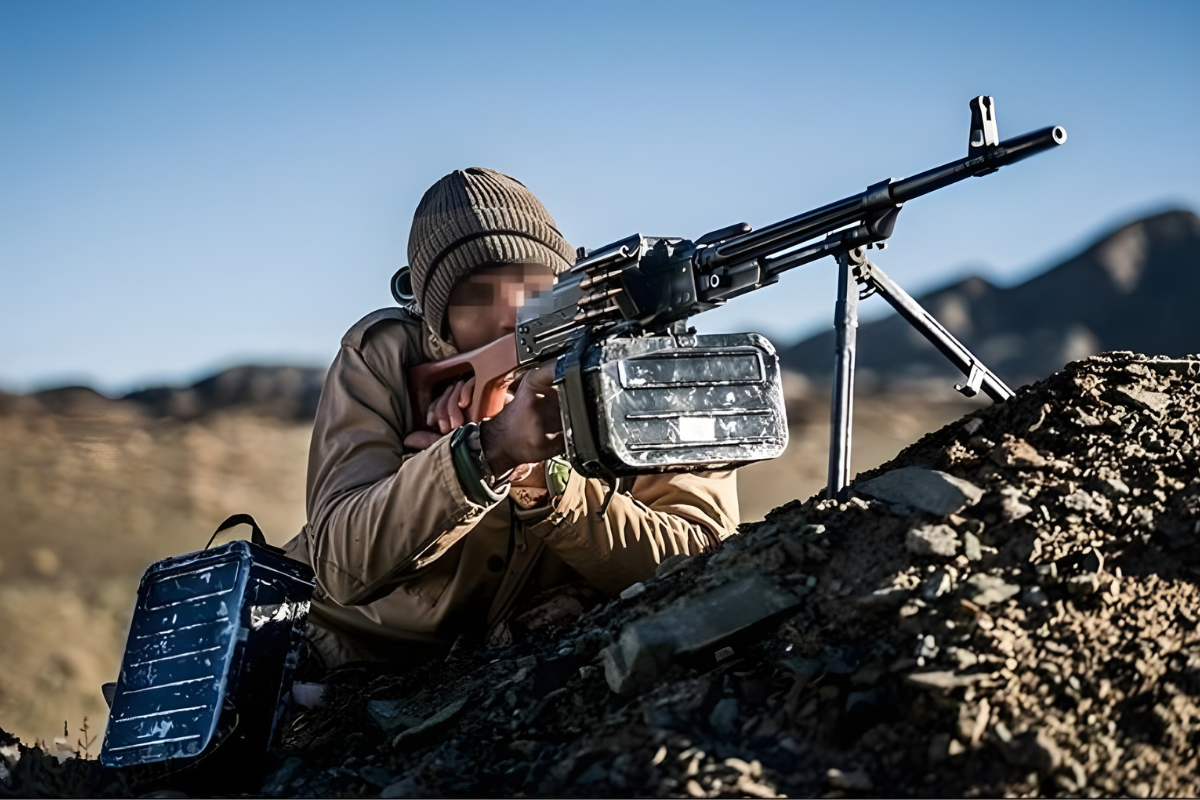
Photo Caption: A member of the Islamic Revolutionary Guard Corps. (Credit: Tasnim News, via Wikimedia Commons)