
On Immigration, Europe and the US are Increasingly Aligned
American Community Media. Terra 360.
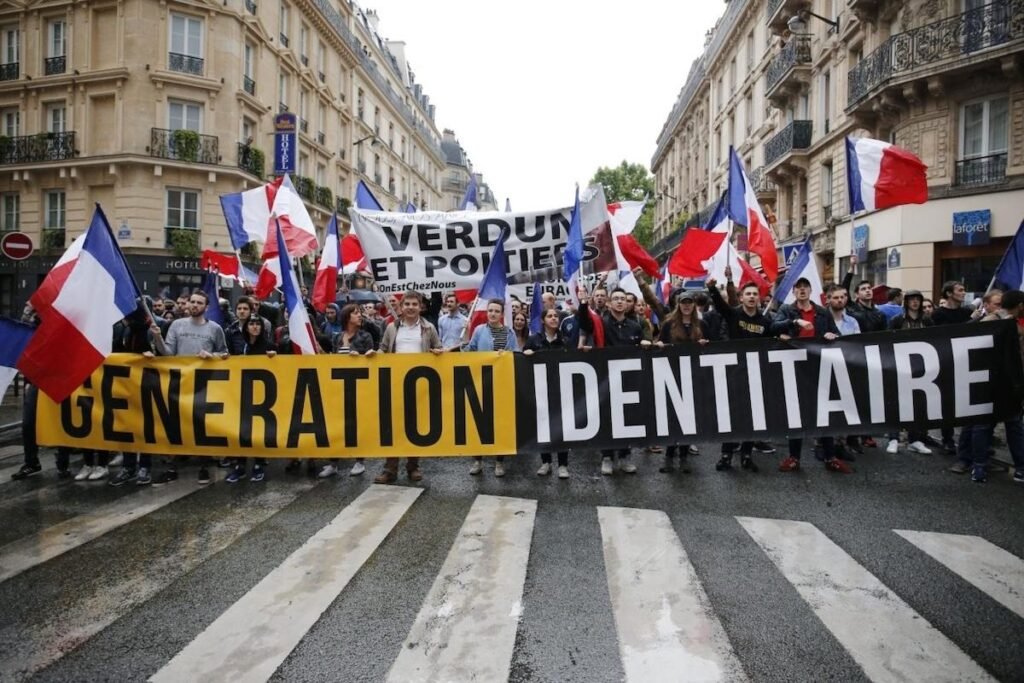
Supporters of the far right Identitarian Bloc march in Paris in 2017. (Wikimedia Commons)
From Brexit and the Great Replacement to Unite the Right, the past decade has seen a growing embrace of far-right movements on both sides of the Atlantic, one defined by a shared commitment to reversing decades of global migration.
And despite rifts over US tariffs and war in Iran, experts say that commitment is hardening as once fringe ideologies have increasingly moved to the centers of power.
“European border policy and migration policy have been far harder edged than American border policy for a long time,” says journalist Ali Winston, who covers European and American far-right extremism and federal law enforcement. “They are far, far further down that road than we are.”
The ‘politics of dispossession’
Opposition to immigration was and remains at the heart of the movements that swept the far right into power across Europe, the U.S. and increasingly in Latin America.
Lawrence Rosenthal, founder, chair and lead researcher with the UC Berkeley Center for Right-Wing Studies, calls it the “politics of dispossession.”
“If you think about Black rights, women’s rights, gay rights, they are political movements which are in effect demanding a seat at the table. MAGA and right-wing populist movements are responding to the sense that their seat at the table is being taken away,” said Rosenthal.
“This allows for the explanation,” he adds, “It’s being taken away because of immigrants, and the elites who are self-consciously bringing in the immigrants…what the Trump world is fond of calling an invasion.”
Trump, Europe and the ‘Great Replacement’

Italian Prime Minister Giorgia Meloni and US President Donald Trump at the White House in April, 2025. (Wikimedia Commons)
Trump’s political ascendancy famously came in 2015 with his speech describing migrants as rapists and criminals. His return to the White House in 2025 was fueled in large part by widespread anger over border policies under his predecessor, Joe Biden.
In Europe, the galvanizing event for the contemporary far-right was also around 2015; the mass movement of refugees into Europe — mostly Muslim, mostly from Syria and other countries convulsed by the geopolitical catastrophes collectively called the “Arab Winter.”
It was around that time that Europe began to see the rise of white identitarianism, an ethnic replacement reactionary movement originating in early-2000s France as Bloc Identitaire (“Identitarian Bloc”). The idea, he says, dates back to 1930s National Socialism under the Nazis, with parallels in France, Italy, Spain and, to a lesser extent, Great Britain.
“They used the influx of non-European migrants, and the provision of aid by European governments to those populations, as an organizing cry,” explains Winston. “It was a way to popularize the notion that indigenous European populations were being replaced by their governments with Muslim, non-white labor whose goal was to undermine the existing social fabric of Europe for the purpose of profit.”
According to Rosenthal, this theory of a Great Replacement is “the single uniform constituent of all of the right-wing illiberal movements across Europe, North America and parts of South America and Asia.”
Both researchers locate the economic substrate beneath the cultural anxiety. Neoliberal policies since the 1980s eroded social safety nets and widened inequality across the Atlantic world. Immigration provided a ready explanation for dislocations whose actual causes were structural.
“The migrant crisis and [the far right’s] consistent policy positions on limiting immigration dovetailed with a broader reaction to a very true social crisis that put this stuff back into the mainstream of European politics,” Winston explained.
A ‘fascist international’
The transatlantic transfer of these ideas moved through alt-right channels — particularly the neo-fascist online forum Iron March, which spawned groups including Vanguard America (now Patriot Front), the Atomwaffen Division and the Rise Above Movement. Members traveled to Europe to meet with counterparts in European organizations including Ukraine’s Azov Battalion and Britain’s National Action.
“Iron March — that really was the conduit,” Winston said.

Far right protestors during the 2017 Unite the Right march in Charlottesville, North Carolina. (Wikimedia Commons)
Earlier decades lacked the global communications infrastructure that could lend itself to what Rosenthal describes as a “fascist international.” But, he adds, “that’s different now. There is a self-consciousness across borders.”
The crystallizing moment came in Charlottesville, Virginia in August 2017, when a far-right coalition spanning the Proud Boys to explicitly neo-Nazi factions marched in the streets chanting “You will not replace us” and “Jews will not replace us.”
Rosenthal says as France exported replacement theory to the U.S., the American fixation around a broader identity of “whiteness” as a political organizing principle traveled back to Europe.
Less than a decade later, in the US at least, the distance between Charlottesville and official policy has effectively closed, says Winston.
“Within a decade,” he explained, “we have the White House’s formal policy and the state department’s formal statements, and there’s no daylight between them and what was said in Charlottesville in 2017. That’s replacement theory and white nationalism as official state department policy.”
From streets to state
In his recent book “Empire of Resentment” Rosenthal traces the transformation of right-wing populism from 20th-century fascism to contemporary Trumpism. In it, he draws a pointed historical comparison: What defined fascist movements in Italy and Germany was “the marriage between an electoral party and the private militia” and the eventual absorption of those paramilitaries into state structures.
“In both Italy and Germany, the militias became part of the state apparatus,” he said. “I believe to some extent that’s happening with ICE — that the people in ICE are the same population, as it were, as the people who appeared on January 6th and were convicted and then amnestied.”
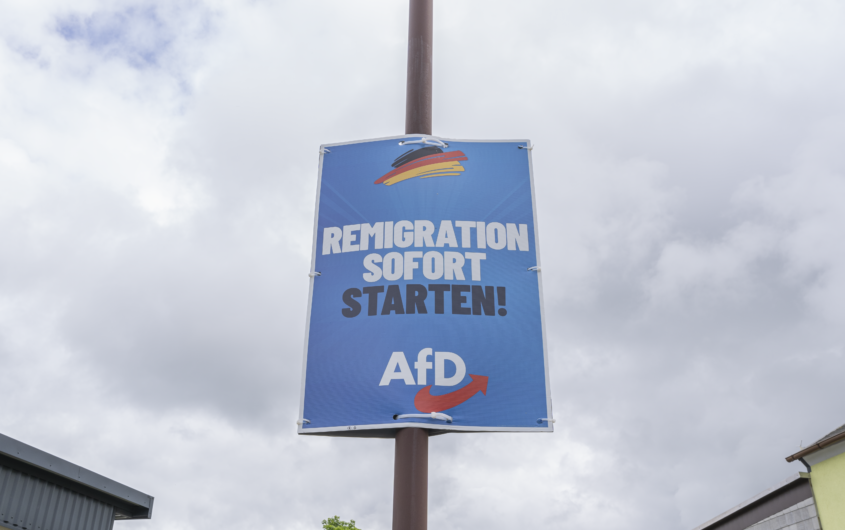
A poster for the far right AFD party in Germany reads, “Start remigration now.” (Wikimedia Commons)
The American system accelerates the consolidation of the state and the militia in ways that European parliamentary structures can’t. The U.S. presidency concentrates executive power in a single office, while even the most hardline European nationalist leaders — Italy’s Meloni, France’s Le Pen, etc. — remain constrained by coalition politics, constitutional courts, and EU law.
When Meloni campaigns on immigration crackdowns, for instance, then agrees to issue 500,000 visas to undocumented workers to address labor shortages, this gap between rhetoric and governance becomes visible.
“Trump has one extraordinary tool,” Rosenthal said: the Supreme Court’s 2024 ruling of presidential immunity from prosecution. “That releases him to act above the law, which is the very definition of — let’s call it the Führerprinzip.”
What replaced street militancy?
In the U.S., street-level far-right militancy of the kind seen in Charlottesville has actually declined in recent years.
That is partly the result of federal prosecution of January 6th participants, which caused internal rifts within the organizational structures of groups like the Proud Boys and the Oath Keepers.
Under President Biden, the federal counterterrorism apparatus zeroed in on far-right extremism with measurable effect. For example, the Proud Boys’ former leader Enrique Tarrio was outed as a government informant, damaging both the group’s reputation and its recruitment pipeline. But a more moderate political landscape did not follow.
“David Duke-style ideas have become the mainstream of the Republican party,” Winston said, referring to the former KKK leader. “Mass deportation, ethnic cleansing, specific campaigns to get certain nationalities out of the country — the way the government has gone after Somali Americans is pretty telling.”
What the decline of street organizing actually reflects, he continued, is that “militant groups don’t need to be on the street anymore because they see the policies they want being pushed by the federal government. What’s the point in being on the street when you have the full weight of law getting behind your whole program?”
Conflicting interests, shared vision
There are more than 50 far right parties across Europe. Together they hold or support governing coalitions in seven EU countries, with polls showing them continuing to gain in strength and support.
Much like Trump’s America First, their popularity stems in part from an appeal to sovereignty and national identity, principles that now appear to be crashing headlong into this second Trump Administration.
Recent signs of the emerging rift between the European far right and the U.S. come via comments from one of the top leaders of Germany’s AfD party, Tino Chrupalla, who accused the Trump Administration of “war crimes” in its conflict with Iran. Germany has also distanced itself from Israel, a key U.S. ally.
Indications now suggest that skyrocketing energy prices and international economic instability as a result of the war on Iran threaten the populist appeal that underpins the right-wing in both continents.
But fissures appeared earlier, beginning with Trump’s hiking of unilateral tariffs in January 2025. The move alarmed even right-wing leaders like Hungary’s Victor Orban and Italy’s Giorgia Meloni. Trump’s repeated threats to take Greenland, moreover, violated key tenets of sovereignty and national identity central to the European far right, which has long bristled under EU governance.
Still, says Winston, when it comes to punitive anti-immigrant measures the movement of far-right ideologies from the streets to the state continues apace on both sides of the Atlantic.
The EU pays billions annually to Turkey and Libya to hold migrants, he notes, while its border agency Frontex operates a pushback policy in the Mediterranean that results in hundreds of deaths each year. Britain’s current left Labour government, meanwhile, is renegotiating to restrict asylum law.
“The Europeans are operating with a very draconian migration regime to date,” Winston says. “In many ways, there are deep similarities between what European governments are proposing and the Trump administration.”
This story was originally published by American Community Media (ACoM), a media partner of Terra 360.