
The Resistance of the Indigenous Nations of Ecuadorian Amazon
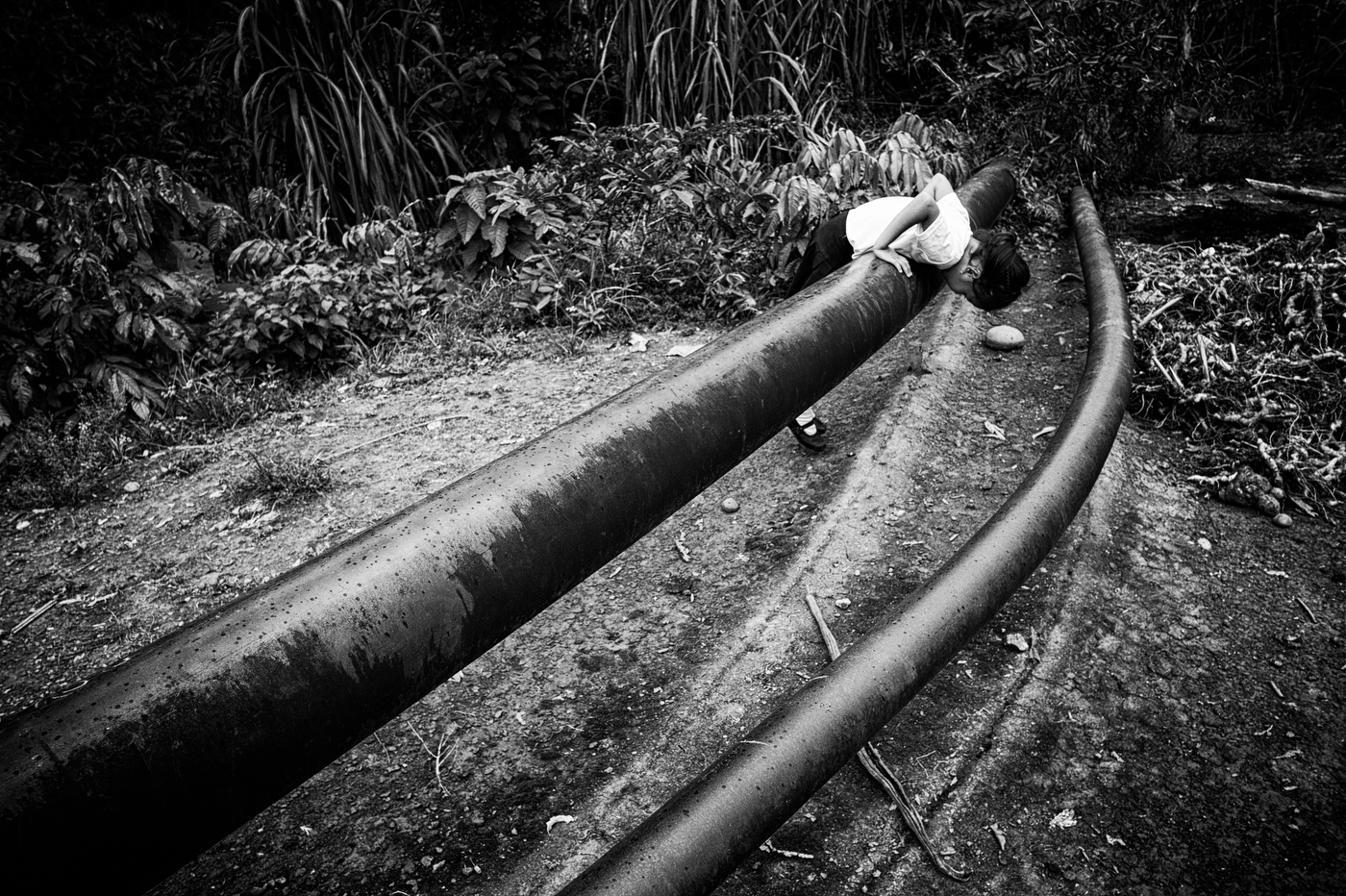
04/12/2018 – El Coca, Orellana Province in Ecuador. Five-year-old Genesis, plays amid Petroecuador’s oil pipes (formerly Texaco’s), running just a few meters away from her home in the outskirts of El Coca in the northern Ecuadorian Amazon. Genesis’ mother, Monica, has cancer, and one of her two other children was born with a congenital disease. Monica says that some nights the racket made by the oil pumping is unbearable. She also claims that five years ago, downstream, these pipes were responsible for an oil spill, and yet, Petroecuador’s staff deny this by assuring everyone these are just water pipes. 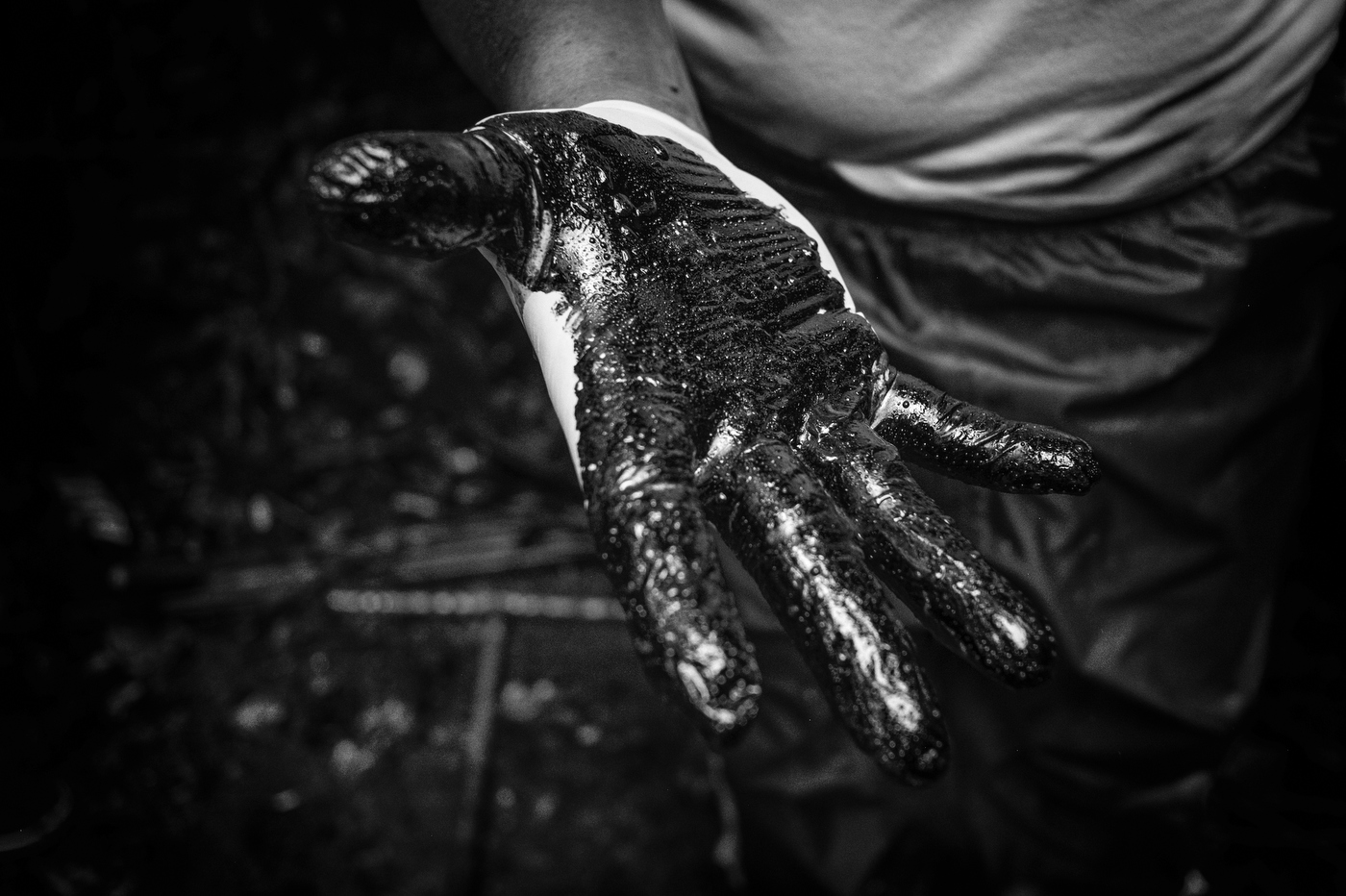
18/07/2017 – Nueva Loja, Sucumbíos Province in Ecuador.
Donald Moncayo’s hand showing proof of the oil that Texaco negligently dumped around 48 years ago into one of the many waste pools surrounding the Aguarico oil well (AG-04) in Sucumbíos Province. Moncayo, a leading member of the Union of People Affected by Texaco’s Oil Operations (UDAPT), recounts that the oil giant (now owned by Chevron) merely covered up its highly toxic oil-waste pools with dirt and left the land.
Texaco’s infamous operation in Lago Agrio, where the company dumped toxic oil waste into the Ecuadorian Amazon rainforest, polluted a swath of northern Ecuador where hundreds have died of cancer. At least 68 billion liters of toxic waste and 64 million liters of crude oil were dumped on sensitive rainforest soil in an area spanning 4,400 square kilometers. The situation dubbed the ‘Chernobyl of the Amazon’ has threatened the lives and livelihoods of numerous indigenous communities, small farmers and countless species of flora and fauna.
The UDAPT is a non-profit organization that brings together communities belonging to 6 indigenous nationalities (Waorani, Siekopai, Siona, Kofan, Shuar and Kichwa) and about 80 peasant communities settled in the area contaminated by the transnational Chevron-Texaco. In 1993, the union initiated a class-action lawsuit against the oil company for the damage caused in the provinces of Sucumbíos and Orellana in the Ecuadorian Amazon.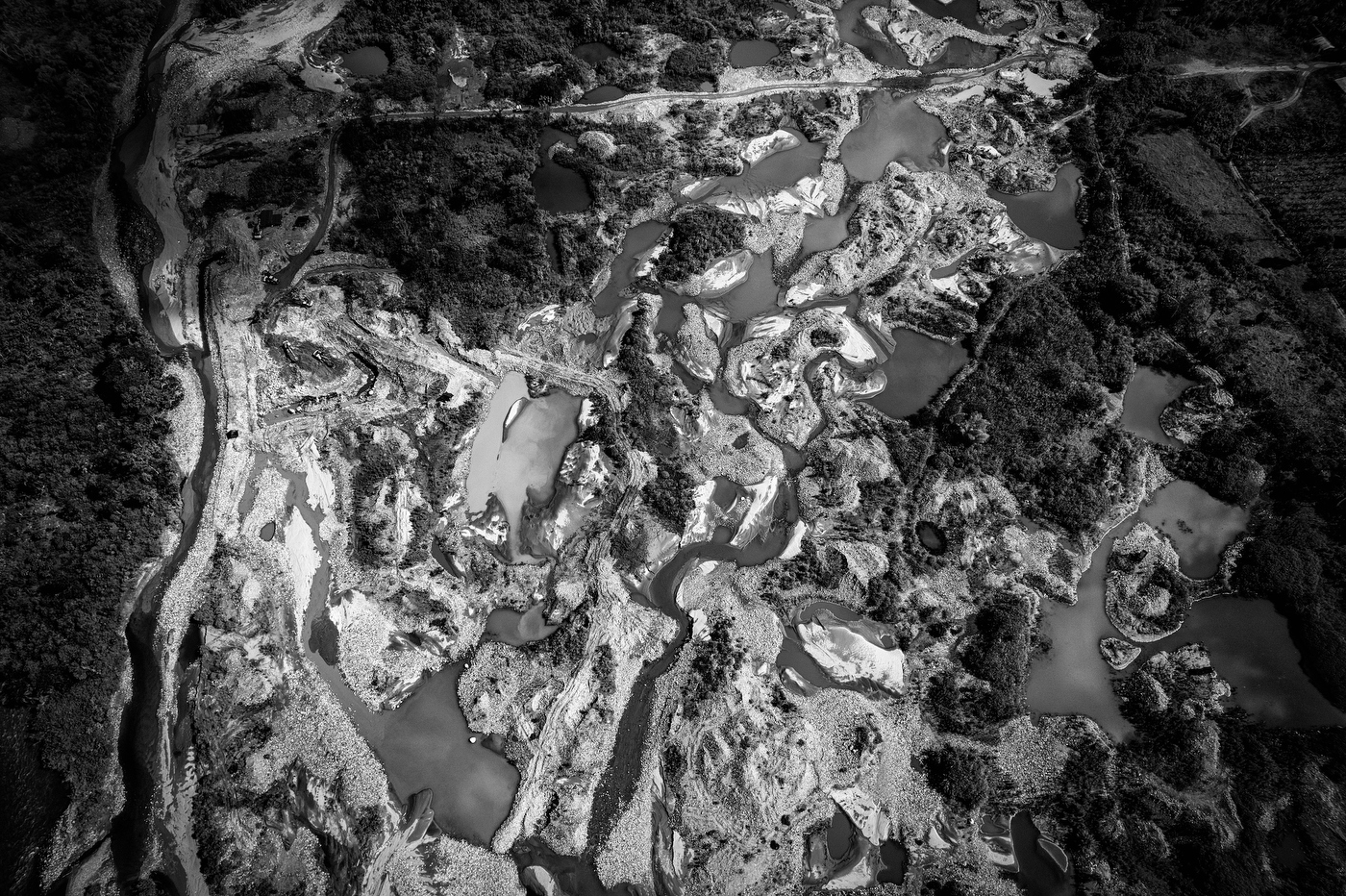
27/07/2023 River Jatunyacu, Yutzupino, Napo Province in Ecuador.
Devastation of the rainforest around River Jatunyacu in the Napo Province of Ecuador caused by illegal gold mining perpetrated by criminal groups. The excavation pits left behind are dangerously polluted with mercury and other toxic waste.
In the latest report by Andean Amazon Monitoring project (MAAP) and the Ecociencia Foundation, Napo was the province with the greatest legal and illegal mining expansion. By 2021, nearly 1,125 hectares were dedicated to this activity, representing an increase of 316% in less than 6 years. The study points out that “mining is already an important direct cause of deforestation” accounting for river pollution, negative impact on Indigenous livelihoods and 46% of the forest loss.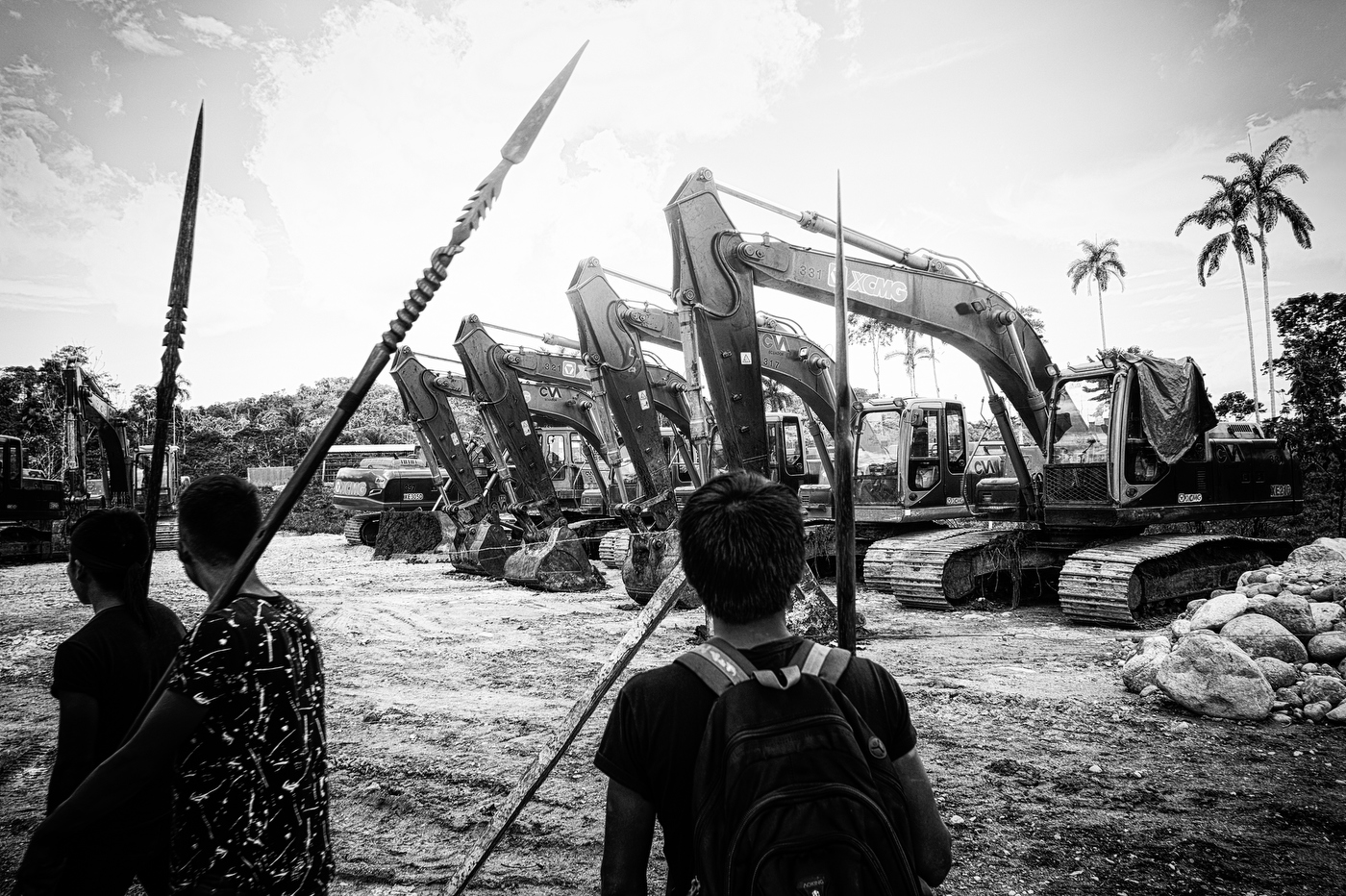
14/11/2018 Kichwa Santa Clara community, Pastaza Province in Ecuador.
Young Kichwa men stand guard near the caterpillars set to excavate the forest for the construction of Genefran’s hydro-power plant over Piatúa River. The project did not offer prior, free and informed consultation to the Santa Clara community as it should have according to law. Genefran’s preliminary construction work was halted by Indigenous protesters in defense of the river Piatúa, the community’s main water source.
The Piatúa, a tributary of the Amazon located in the Pastaza region of Ecuador, is thought to be millions of years old, home to one of the most biodiverse areas of the world, where flora and fauna is yet to be know. For the Kichwa Indigenous people of Pastaza, the Piatúa river is sacred: it is a living being, revered and feared, loved and protected.
20/07/2023 Parish of Taracoa, Orellana Province, Ecuador.
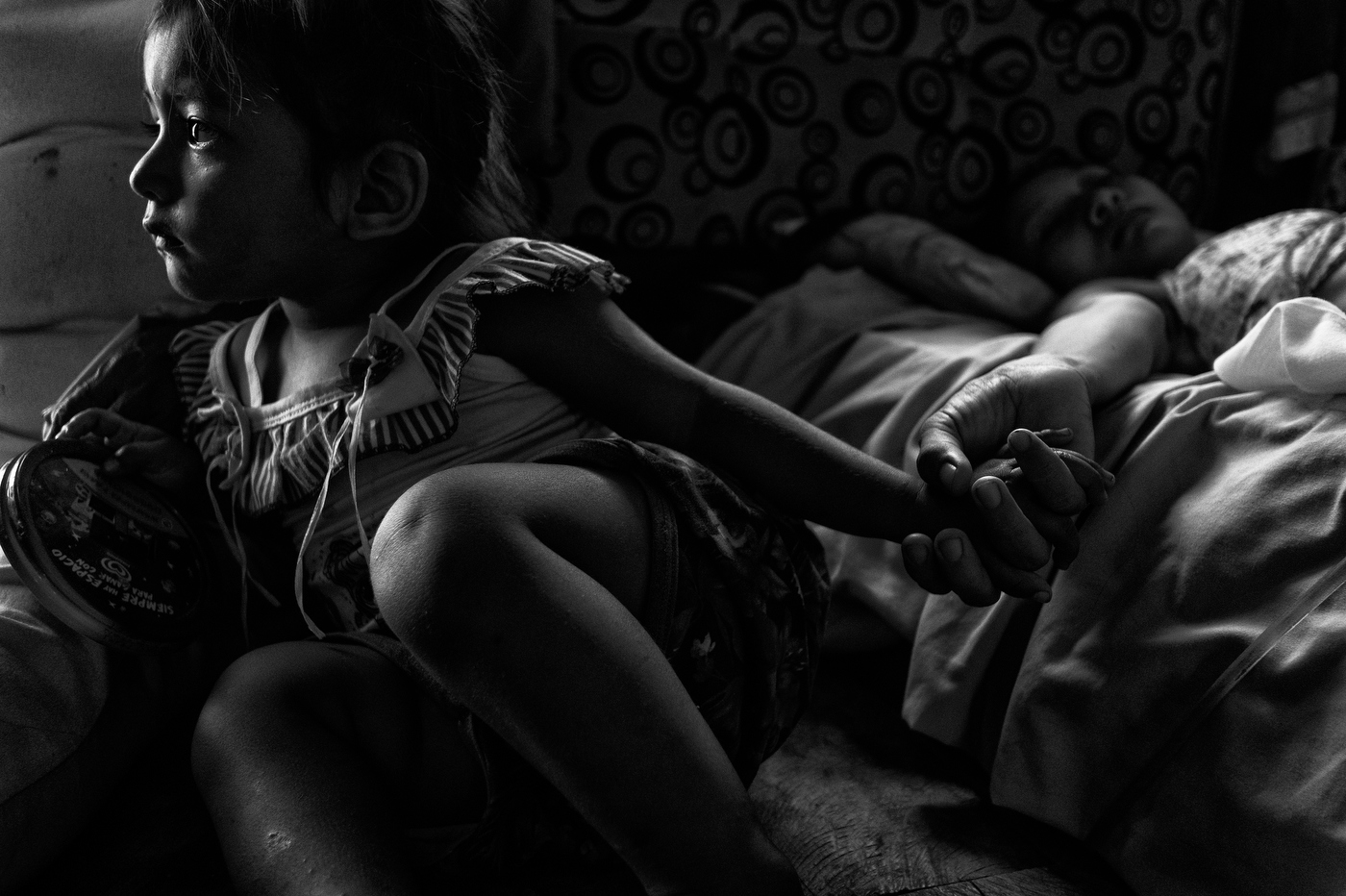
Ligia, 26 years old, in the background, holding the hand of her daughter in the parish of Taracoa, Orellana province, in the Ecuadorian Amazon. Ligia cannot walk. She used to live in the Shuar Community of San Vicente, near the Rumiyacu River, where, in the year 2000, there was a fatal oil spill. Ten months before this picture was taken, she began experiencing dizziness and leg-tingling until she lost her capacity to walk, becoming permanently bedridden and dependent on painkillers that she cannot afford. Her husband abandoned her when the illness surfaced. In February 2023, she underwent surgery in Guayaquil for cervical cancer. Since then, she has been waiting for her medical certificate to confirm her right to receive a monthly stipend of $240 USD from the State due to her 70% disability caused by an illness resulting from catastrophy. A recent study by the Union of People Affected by Texaco’s Oil Operations (UDAPT) confirms that the rate of cancer patients in Ecuador is much higher in provinces with extractive activities.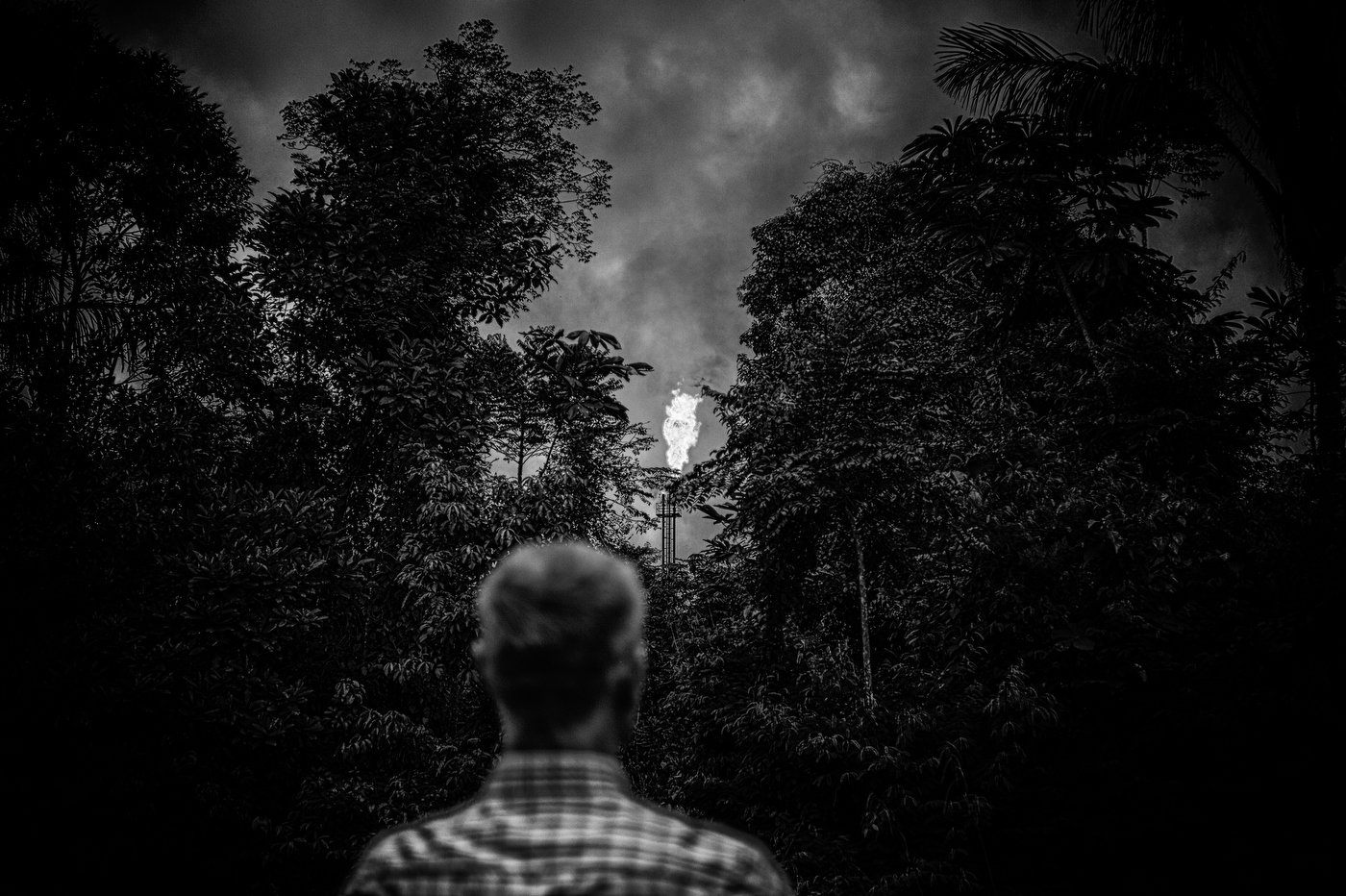
18/07/2017 Dureno community, Nueva Loja, Sucumbíos Province, Ecuador.
Helmut Scholz, then member of the EU Parliament, looking at Petroecuador’s gas flaring in the distance. His visit to Nueva Loja, Ecuador, together with fellow parliamentarian Lola Sánchez Caldentey, was part of a delegation assessing the environmental disaster committed by Chevron-Texaco. The oil spill due to industrial malpractice, often dubbed by environmentalists the ‘Chernobyl of the Amazon’, is considered one of the worst in recent history.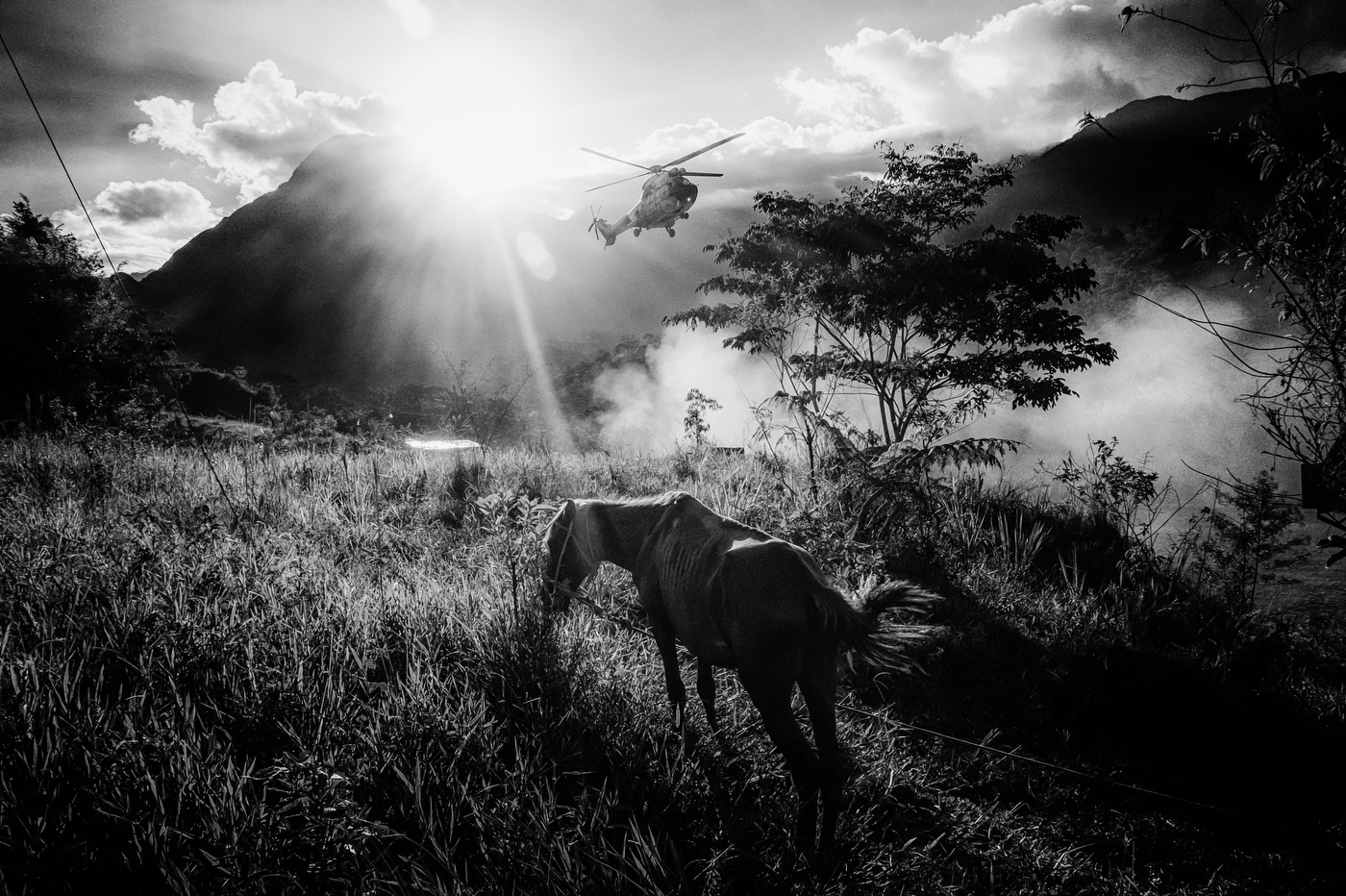
24/11/2016 San Juan Bosco, Morona-Santiago Province, Ecuador.
An Airforce Ecuadorian Army (AEE) helicopter takes off from a school’s soccer field in the San Juan Bosco Parish, Morona-Santiago Province, Ecuador. For a few days, the Army made its headquarters in the school to attack the Shuar community residents of Tsumtsuim, who had decided to recover their territory after a forcible eviction from their homes in Nankints on August 2016.
According to official reports from the Confederation of Indigenous Nationalities of Ecuador (CONAIE), the Ecuadorian Army carried out a repressive operation in support of the Chinese mining company ExplorCobres S.A. (EXSA) so it could begin extractive activities in the town of Nankints, Panantza Sector, Morona-Santiago Province.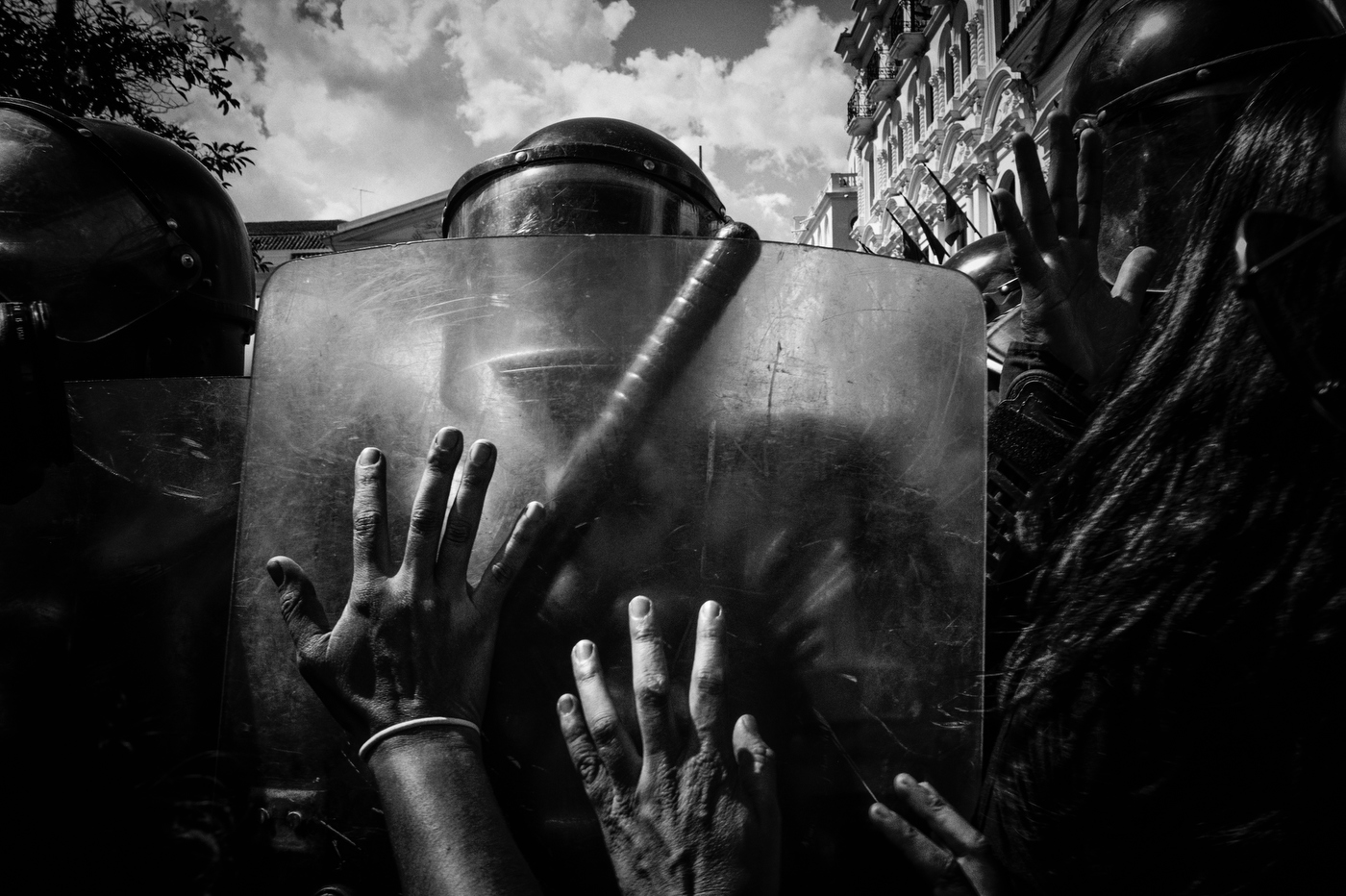
28/12/2016 Plaza Grande, Quito, Pichincha Province, Ecuador.
Women hands on riot police shields during a clash between protesters and police force in Plaza Grande, Quito. The protest called out the government’s military attack and repression in Nankints that, favoring Chinese corporate extractive activities, maintained a state of exception in the province of Morona-Santiago.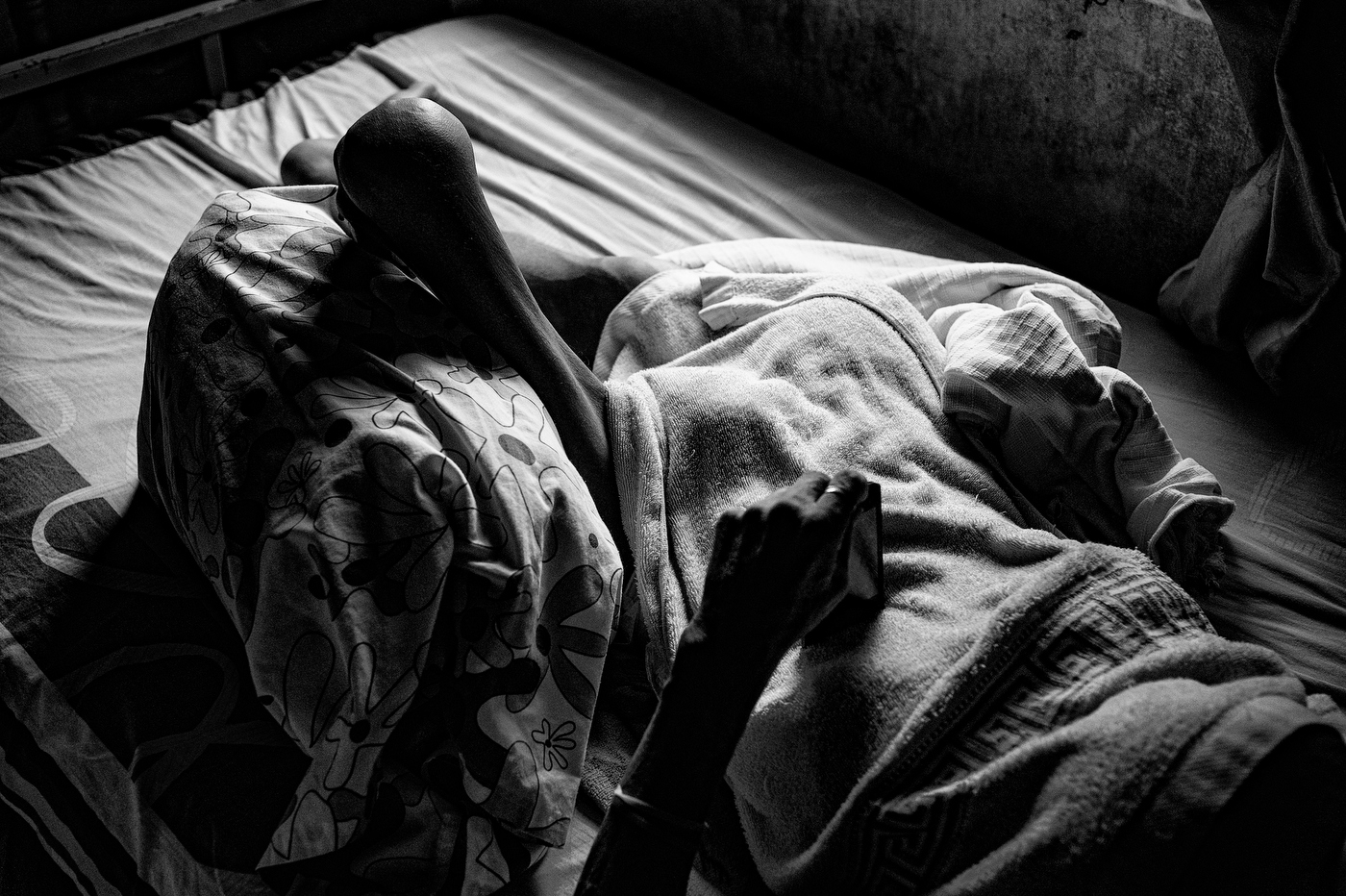
03/12/2018 El Coca, Orellana Province, Ecuador.
Pedro, 47 years old, lies bedridden with advanced cancer at his home in the Santa Rosa neighborhood of El Coca town. He and his family are part of the hundreds of victims afflicted by Texaco’s negligent oil waste dumping in the area that is now being worsened by Petroecuador’s oil-rig gas flaring. The Zambrano family receives a $100 USD State compensation for the terminal diseases afflicting three of its members: two children with hydrocephaly and the father with cancer. Five-year-old son (2018) lives with an 82% acquired brain disability while his fifteen-year-old daughter (2018) exhibits a 72% disability.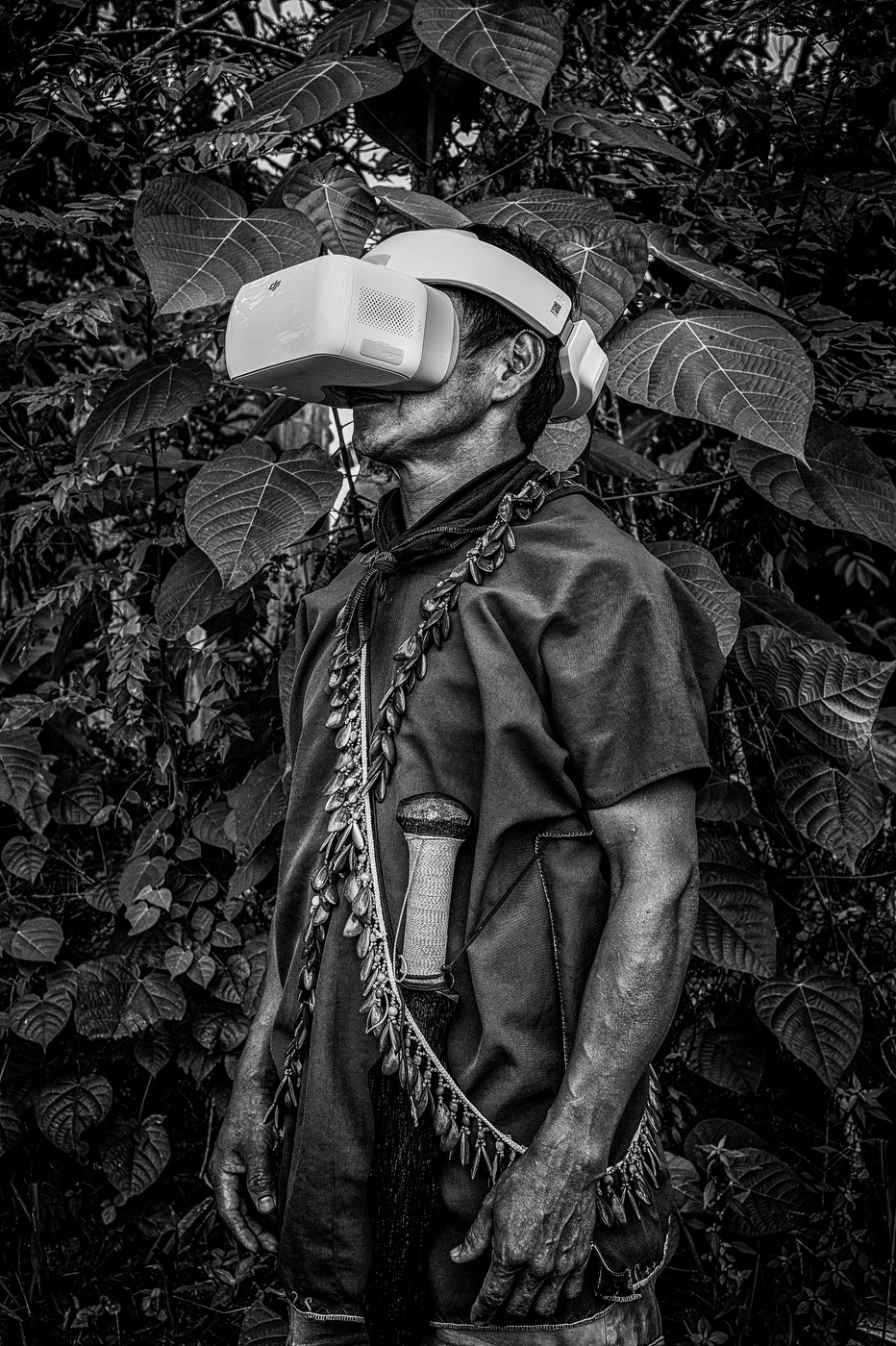
07/12/2018 Sinangoe Ai’Kofan community, Sucumbíos Province, Ecuador
Osvaldo, an indigenous member of the Kofán community of Sinangoe, is wearing a drone navigation visor during a training day for drone use and GPS locators imparted by NGO Amazon Frontline. On October 22, 2018, the Kofán people of Sinangoe, in the Ecuadorian Amazon, won a historic legal battle to protect the headwaters of the Aguarico River, one of the largest and most important rivers in Ecuador: fifty-two mining concessions that had been granted by the government in violation of the Kofan’s right to consent were annulled, freeing more than 32,000 hectares of primary rainforest from the devastating environmental and cultural impact of gold mining.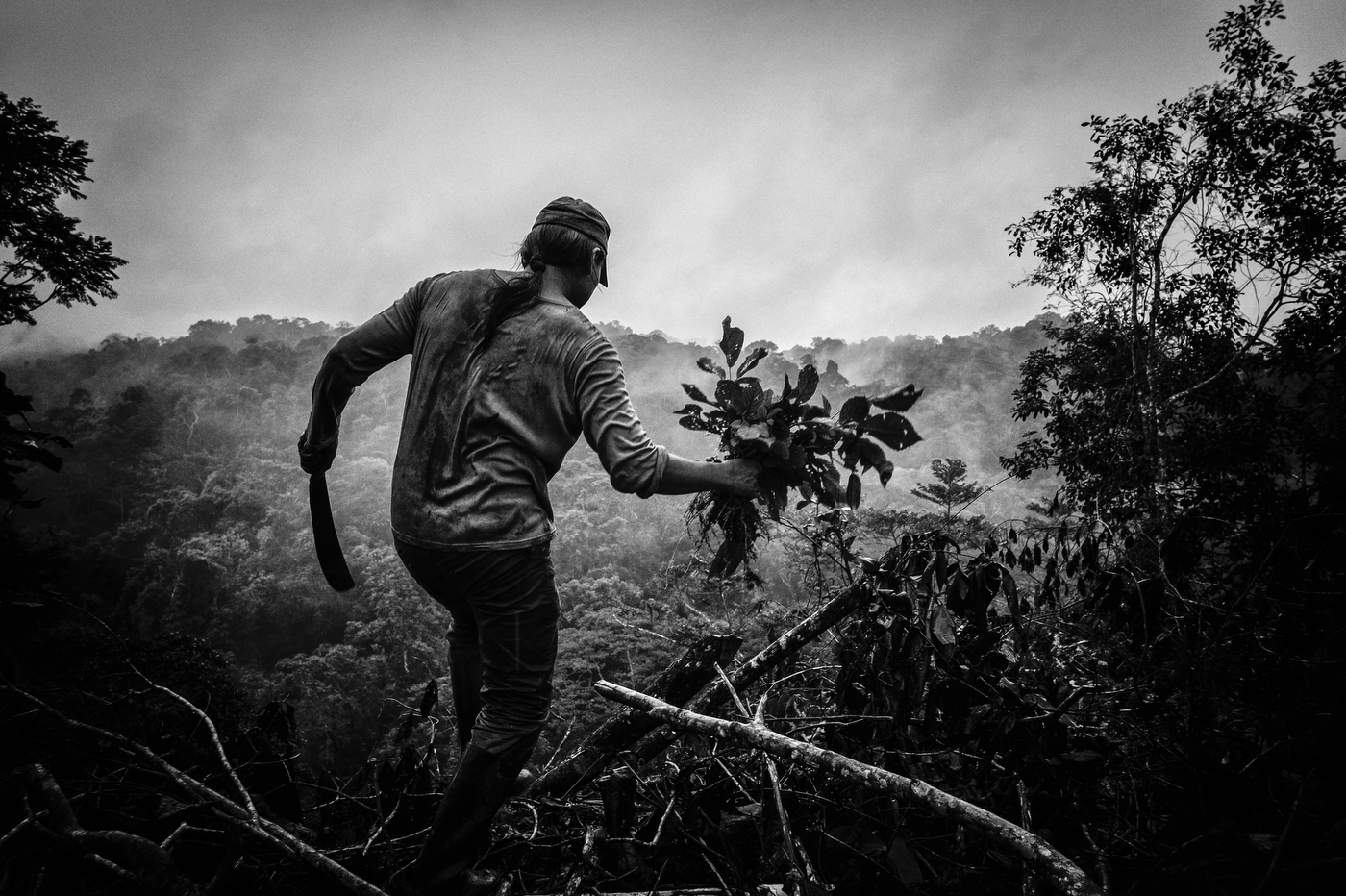
03/04/2019 Sarayaku community, Pastaza Province, Ecuador.
On a rainy day, Antonio Mayancha, a Kichwa member of the Sarayacu community who coordinates the project Sisa Ñampi (Border of Life), plants trees along a specific perimeter in the forest. In twenty to forty years, these flowering trees will exceed the height of the other surrounding vegetation and delimit, in air and land, the confines of the sacred Kichwa territory by way of their colorful blooming canopies. This is an example of the manifold tactics the diverse Indigenous peoples of the Amazon implement to protect their ancestral territories.
The Kichwa of Sarayaku have fought for the conservation of their territory since the first arrival of oil companies into Ecuador. The community’s resistance has remained a united front defending the rainforest and preserving their biocultural heritage from extractivism. The Sarayaku, also known as “The People of the Midday Sun”, owe their name to an ancestral prophecy that saw the Sarayaku as a pillar in the defense of the cultural and spiritual territory of the Ecuadorian Amazon. The Sarayacu are said to be “a beacon of light shining as bright as the midday sun” and the last unfaltering people that will face the extractivist threat.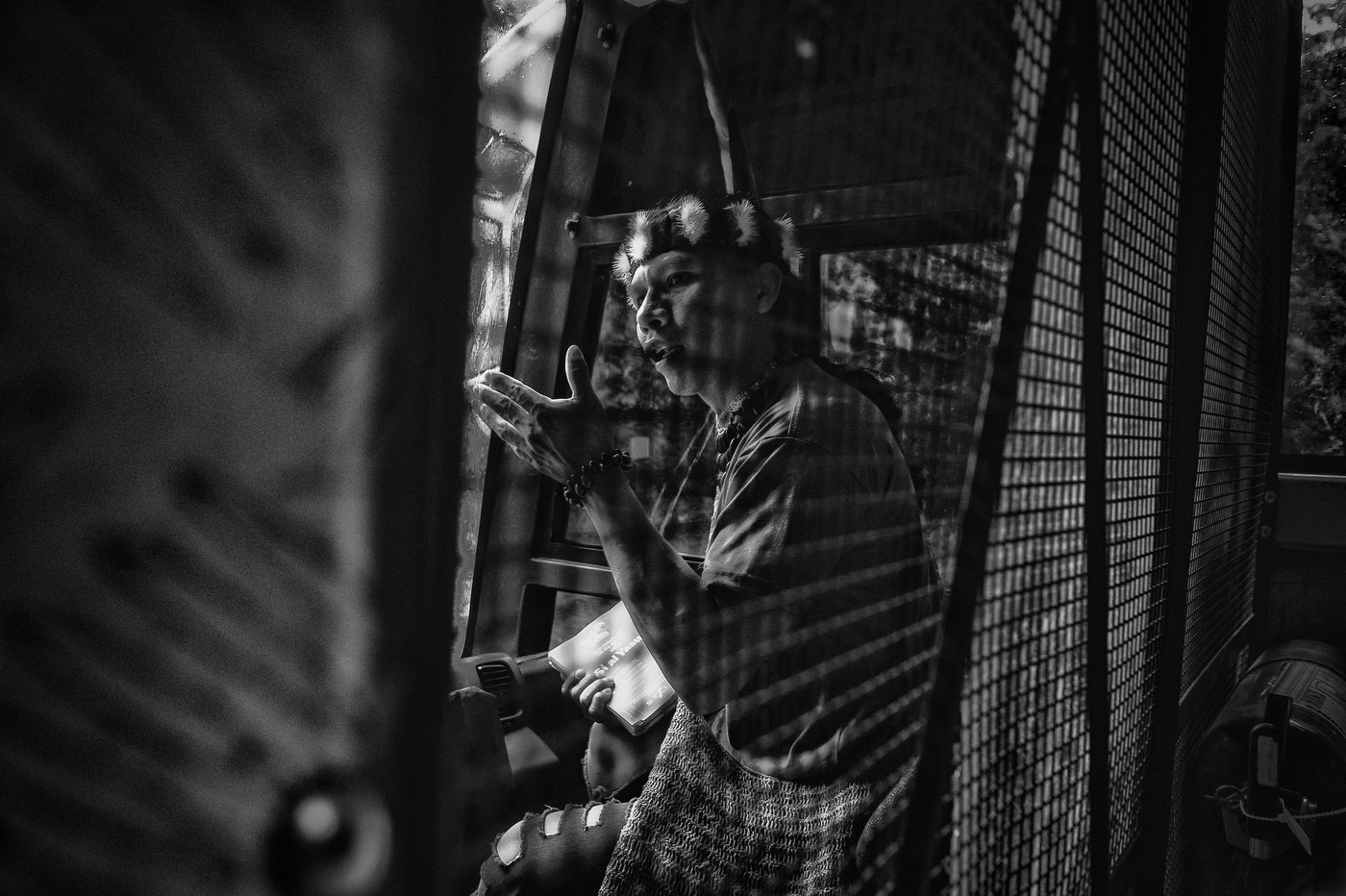
04/08/2023 Waorani community of Guiyero, Block 16 in Yasuni Park, Orellana province, Ecuador.
Ewene Kemperi, a 29-year-old young man belonging to the Waorani community of Guiyero, passionately talks to the bus driver during his bus ride to the grounds of state oil company Petroecuador. Ewene delivers a solid speech that highlights the importance of voting “YES to Yasuni” in the next National Referendum seeking to halt the extraction of oil in Block 43 located amid the Yasuni National Park.
Five years ago, Ewene left his home in Guiyero to obtain an education in the city of Quito and to escape the dangers of alcoholism. Now he has returned with a clear mission: to inform his community and other neighboring ones about the importance of the affirmative vote in the next popular consultation, programmed for August 20, 2023. [As of today, news is the Referendum unprecedentedly won the affirmative vote in favor of halting extraction in Block 43]
The relationship between the Waorani and the extractive companies that took over their ancestral territories (a unilateral non-consensed decision from Ecuador´s government) has been marked by regular conflicts, confrontations and homicidal events. Since 1985, Ewene’s community and others have inhabited the oil-concessioned area, known as Block 16, living under the constant threat of eviction. To mitigate tensions and conflicts with the Waorani people, the company offers free transportation services and free diesel and gasoline in a gesture of good will.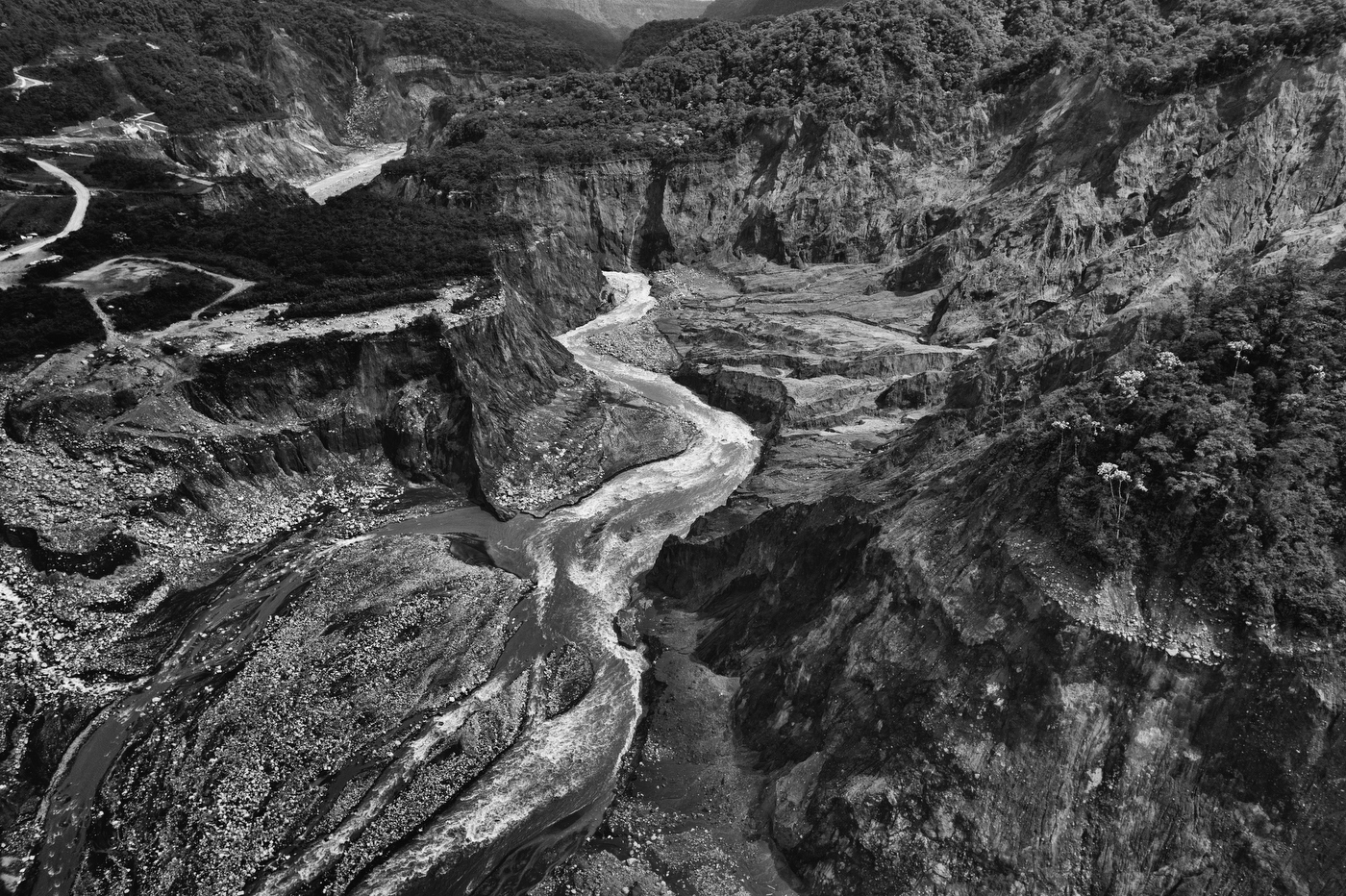
11/01/2023 “Socavón” nearby Reventador volcano, on the Coca River in Napo Province, Ecuador.
Drone picture showing the “Socavón” near the Reventador volcano in the Napo Province. This downstream devastation, indirectly caused by the Coca Codo Synclair (CCS) hydroelectric dam, was produced on February 2, 2020, due to the unstable flow of water created by the CCS dam. Ecuador witnessed the unthinkable collapse of its highest waterfall. As the San Rafael waterfall crashed into the Coca River, the river’s attrition by domino effect ruptured three of Petroecuador’s oil pipelines within the Cayambe Coca National Park.
The oil pipelines of the Trans-Ecuadorian Oil Pipeline System (SOTE) and the Ecuadorian Heavy Crude Oil Pipeline (OCP) that passed next to the river broke, causing a disastrous oil spill where 15,800 gallons of crude oil fell into the river. More than 100 Kichwa communities lost their river, their crops, their food security, and their navigation route.
The contamination of the Coca River, which subsequently spread to the Napo, Aguarico and other Amazonian tributaries affected the livelihoods of 27,000 people, that are now forced to consume water polluted with oil, rapidly impregnating their territories. According to a report from the New York times, the CCS dam was built despite all studies and warnings about the unstable geological conditions made more acute by the Reventador volcano in the area. As the greatest energy project undertaken by Ecuador, the CCS dam is also behind one of the biggest environmental disasters polluting the Amazonian tributaries.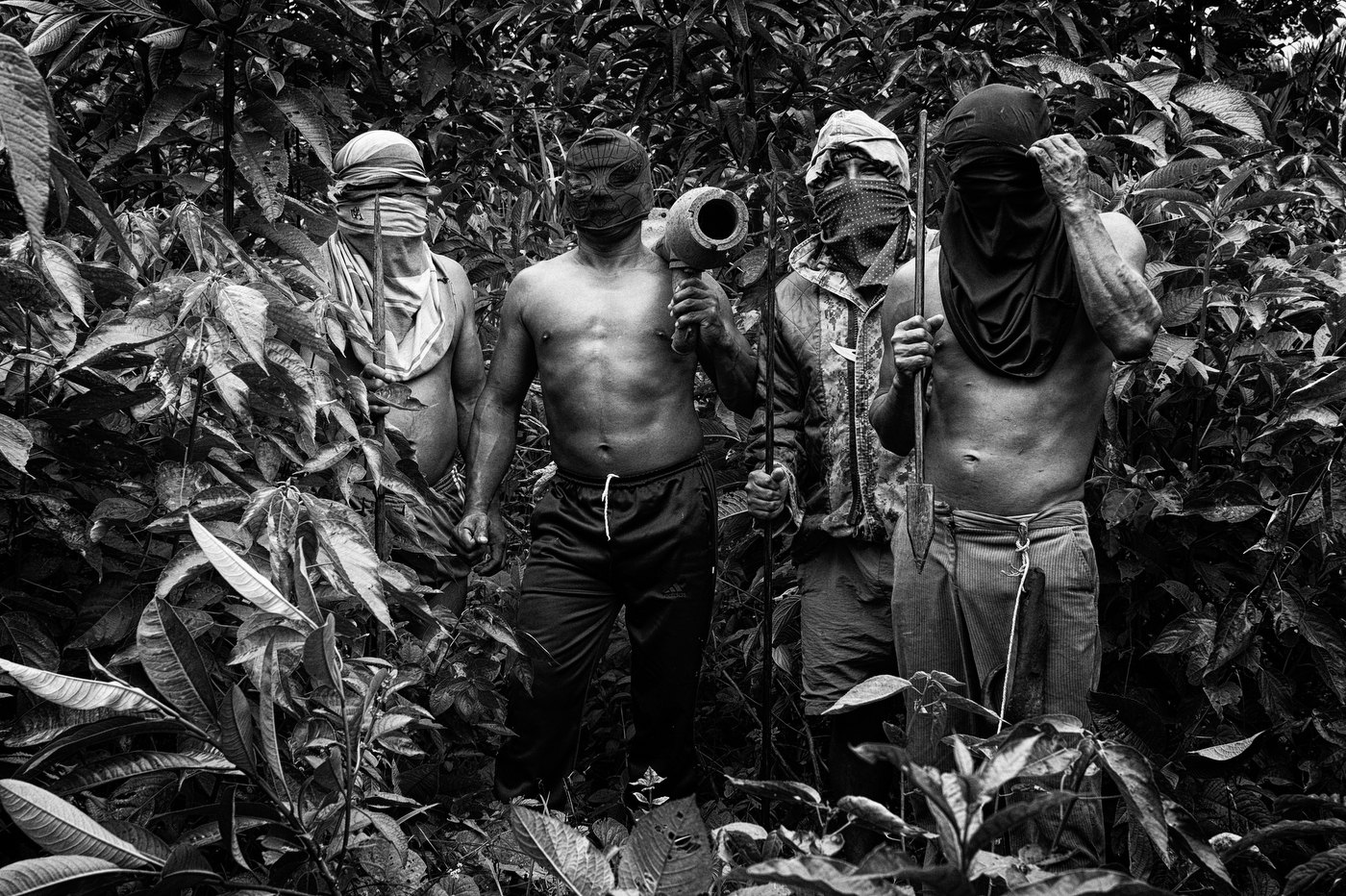
24/12/2016 Shariant community, Morona-Santiago Province, Ecuador.
Group of Shuar Indigenous people pertaining to the resistance in Nankints during the clashes between between Tsumtsuim community members and the military. They are waiting for the radio signal asking them to deploy to the Zamora River where the confrontation would took place.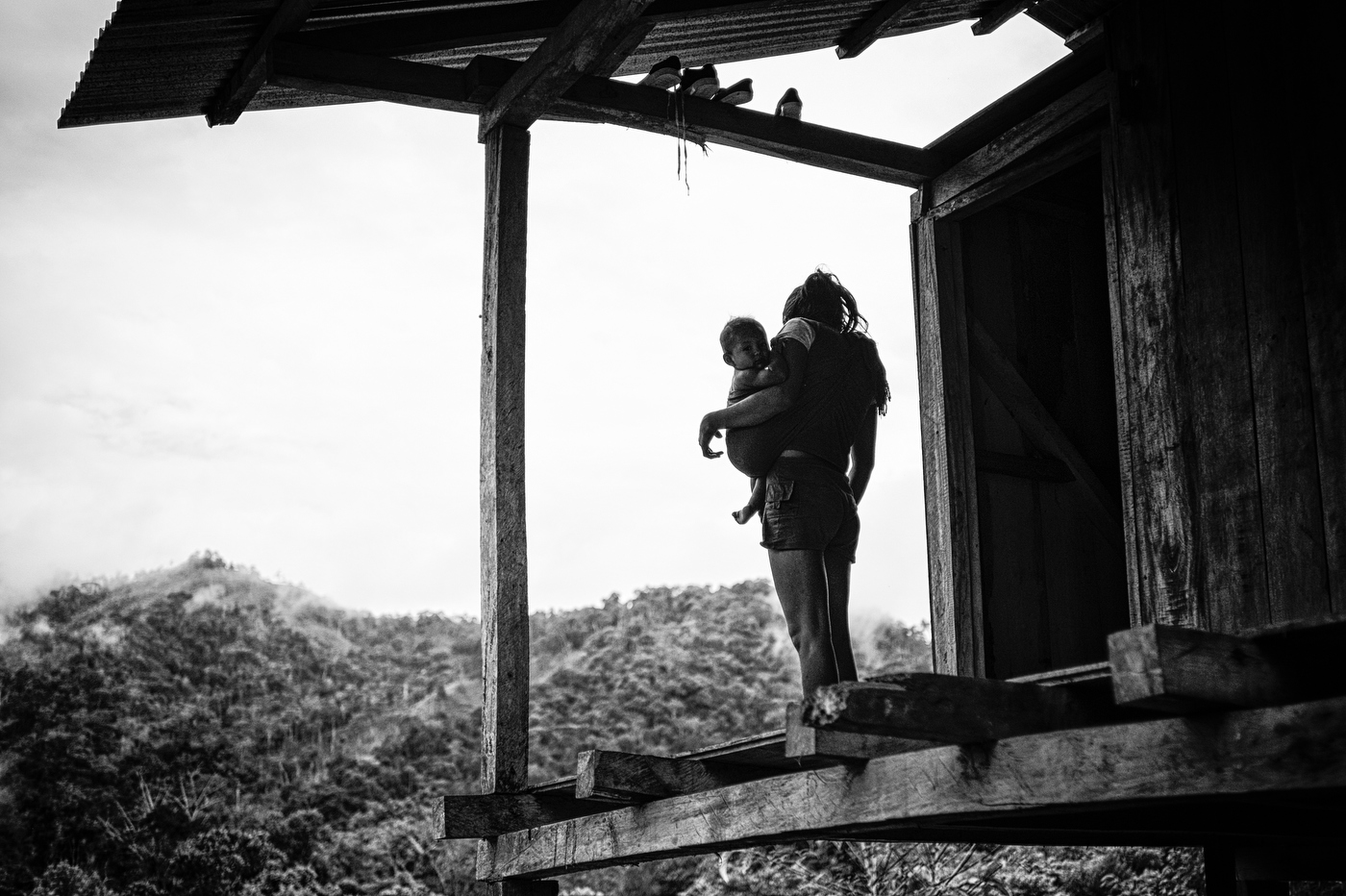
04/07/2017 Tsumtsuim community, Morona-Santiago province, Ecuador.
Gloria, carrying her son in arms, contemplates from her house the valley that extends west of the Tsumtsuim community, just 7 months after their forceful eviction in Nankints. On December 14, 2016, the province of Morona-Santiago was declared under a state of exception. The community of Tsumtsuim was attacked by hundreds of soldiers who shot some of their residents. The 26 families that comprised this community were forced to flee, abandon their homes, and take refuge in the steep forest. Currently, 41,769 hectares of Amazon rainforest have been concessioned by the Ecuadorian government to foreign mining companies.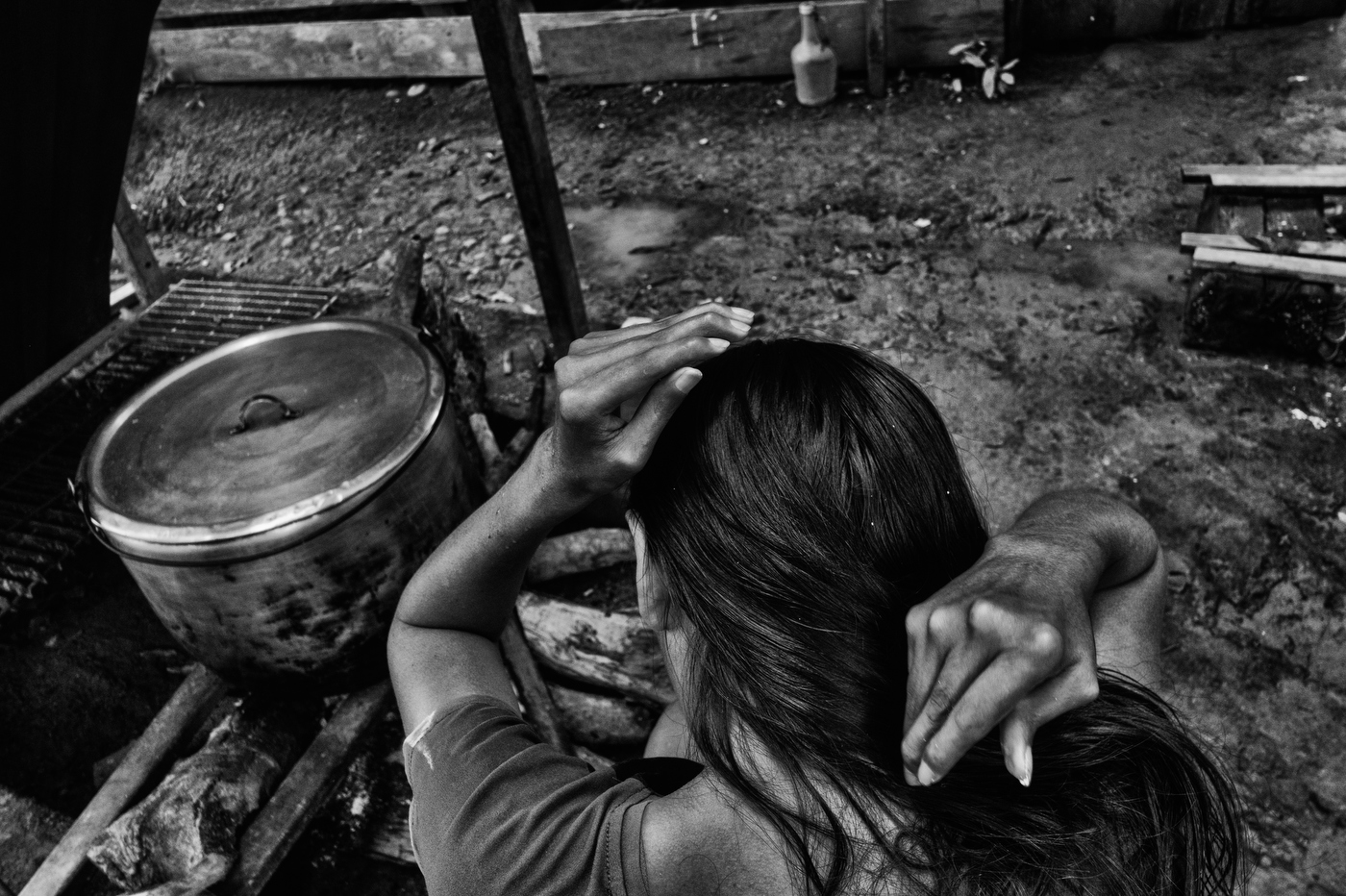
12/01/2023 Rumipamba community, Orellana Province, Ecuador.
Temy, 28, fixes her hair in the patio of her house in the Kichwa community of Rumipamba, Orellana province, Ecuadorian Amazon. Rumipamba is a Kichwa Community divided by a road that was originally built by Texaco to transport the crude oil it extracted only kilometers away from these populations (1964-1992). Temy is related to Maria Guinda, one of the first people to sign in favor of the class-action placed against Texaco for the environmental disaster it caused in the area.
After Texaco left, state-owned company Petroecuador inherited the already deteriorated pipeline infrastructure and facilities formerly built by Texaco. The area where Temy lives is heavily polluted due to the continuous oil spills caused by old pipelines, still in use, and by the negligent disposal of oil waste into land and rivers.
Eventually, Temy, like other people in her community, was attracted by the nearby opportunity to improve her economic situation by working at the Petroecuador plant in Rumipamba. After merely three and a half years of service, she began to lose vision in her left eye, practically lost her right leg to the point she cannot walk except with extreme difficulty, and her hands deformed. A recent study by the Union of People Affected by Texaco’s Oil Operations (UDAPT) confirms that the number of cancer patients in Ecuador is much higher in provinces with extractive activities.
14/06/2017 Llanchama Cocha community, Pastaza province, Ecuador.
Sápara children from the Llanchama Cocha community mock wrestle after a swim in the Conambo River, near the Llanchama Cocha community, in the province of Pastaza. The Sápara are the ancestral owners of the largest indigenous territory of the Ecuadorian jungle. Around 573 Sápara people live in a territory of more than 3,100 hectares. Historical wars between Ecuador and Peru divided the Sápara between Ecuadorians and Peruvians. The remoteness of the cities, the absence of inland roads across the forest, and a river nearly impossible to navigate have kept this territory, rich in oil, naturally protected from extractive threats.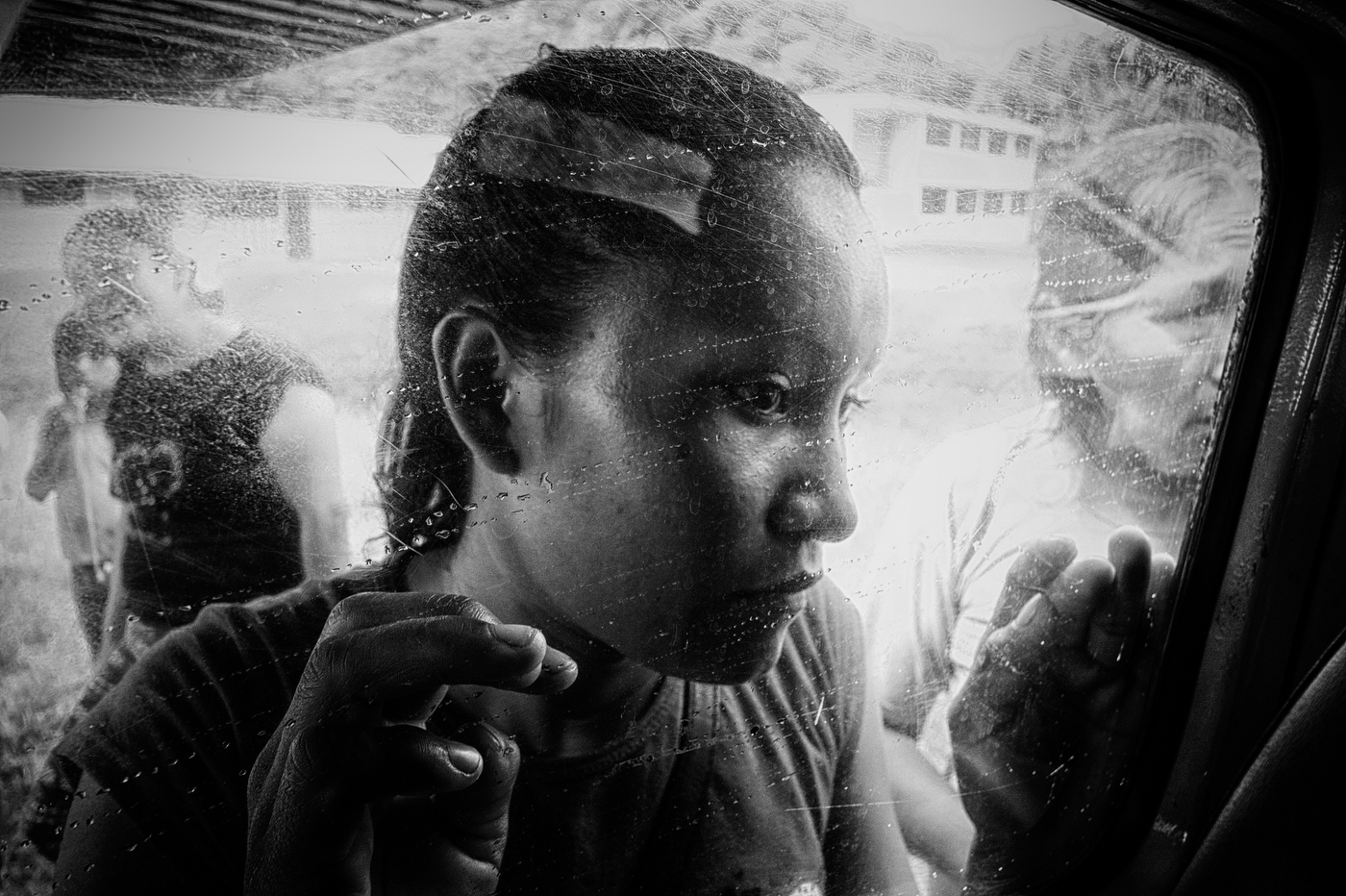
18/06/2017 Morete community, Pastaza Province, Ecuador.
A woman looks through a window into a plane recently landed plane in the community of Morete, amid Sápara territory. Morete, like other communities in this territory, can only be reached by air, since the Conambo River is not navigable at any time of the year. The arrival of a small plane is a special event, and symbolizes contact with the world outside the Amazon.
The border wars of 1941 between Ecuador and Peru as well as the Alto Cenepa war of 1995 divided the Sápara between Ecuadorians and Peruvians. The Sápara are the ancestral owners of the largest indigenous territory in the Ecuadorian Amazon. Currently, Kichwa communities also live in this territory and some of them have begun to consider oil extraction as a solution to their economic instability, without realizing the great health impact, destruction, and pollution that it would cause in their environment. Not far from Morete, in Block 10, a new oil concession threatens the lives of several Sapara and Kichwa indigenous communities, possibly announcing the end of cultures living in close relationship with nature, also threatening the future and integrity of the forest.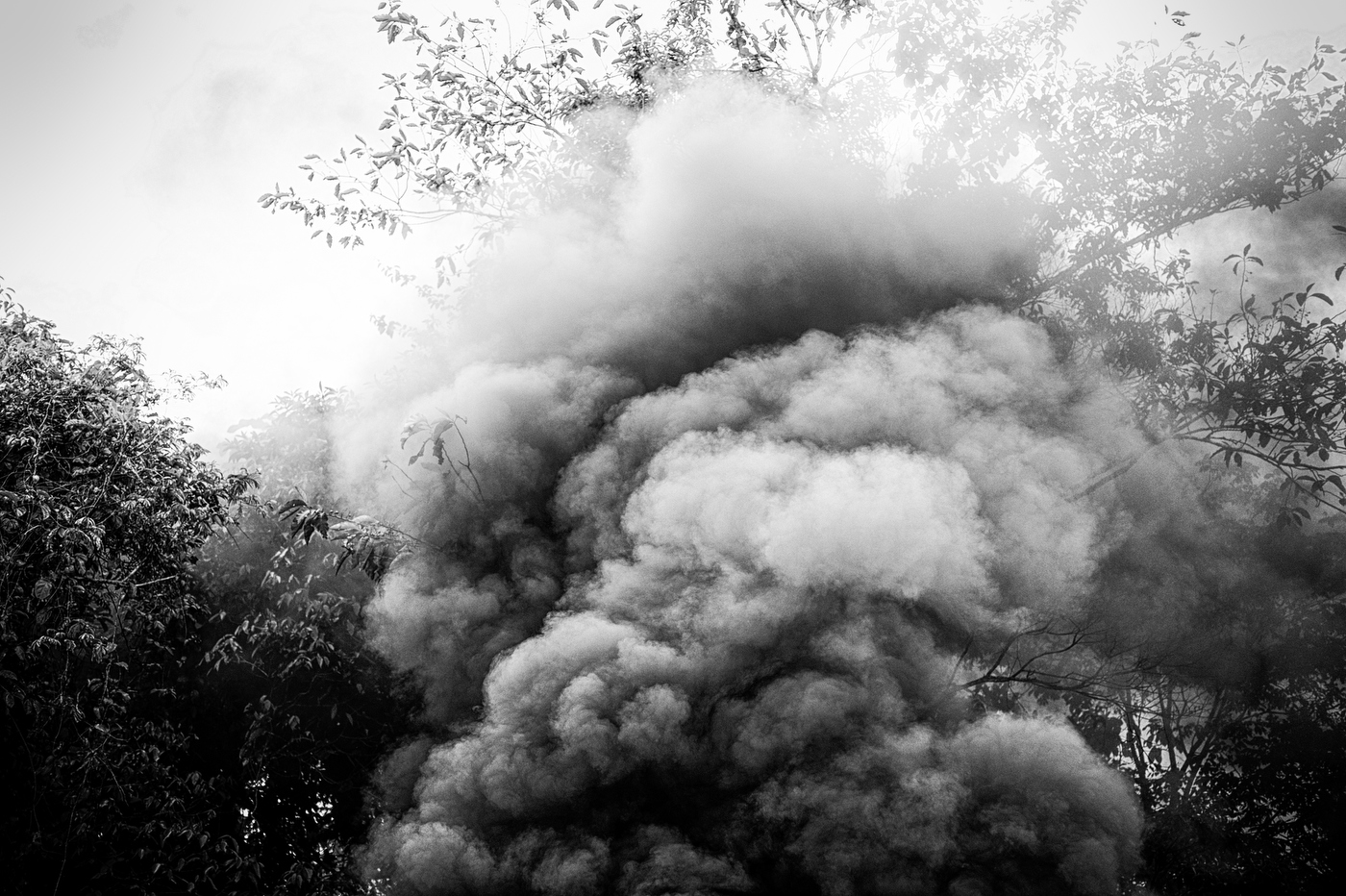
14/11/2018 Santa Clara community, Pastaza Province, Ecuador.
Smoke rising from a tire fire provoked by protesters in the Santa Clara community, near the Piatúa river. The community did not agree to the excavation of the forest for the construction of Genefran’s hydroelectric plant.
Hydroelectric plants damage native river ecosystems by changing the physical, chemical, and biological properties of the river. They cause habitat loss by severely altering water flow (essential for maintaining the species’ environmental conditions) and deter the reproduction of fauna. Moreover, they affect human populations that depend on rivers for their subsistence, such as the Amazonian Indigenous settlements, by altering patterns of fishing, irrigation, and navigation, besides polluting the water with toxic industrial chemicals.
02/04/2019 Bobonaza River, Ecuador.
Kichwa girl jumping off a bridge into the Bobonaza River during a hot afternoon in the Kichwa community of Sarayaku. The Bobonaza river has not been polluted yet by extractive activities, but if it ever were to be threatened, the entire way of life of the Kichwa in the area would be at risk, as these people depend on the river for their sustenance.
The Amazon remains being the largest tropical rainforest in the world thanks to its many tributaries (some of the main ones coming from Ecuador), its rivers supply anywhere from 9 to 30 million gallons of freshwater to the Atlantic Ocean each day. Studies show that, due to human intervention, including mining, oil pollution, hydropower and deforestation, the Amazon suffers the loss of large amounts of surface freshwater. Even small losses of water in the rainforest are capable of altering global water cycles and exposing the Earth to global warming and climate change. By protecting their ancestral territories and rivers, the Indigenous peoples of Ecuador are deterring the destruction of the world’s rainforest.
By Pamela Cruz. Terra 360.
In the Ecuadorian Amazon, where oil runs beneath the earth and mercury poisons the rivers, the rainforest is not landscape: it is memory, it is law, it is spirit. There, Indigenous nations—Shuar, Achuar, Cofán, Waorani, Kichwa, Sápara—are not merely defending hectares threatened by mining and oil concessions, but the possibility of continuing to be.
That is what Nicola Okin Frioli began documenting in 2015 in Piatsaw, a long-term project portraying Indigenous resistance to extractivism in one of the most biodiverse territories on the planet.
“The project began as a search,” the Italian photographer recalls. “I didn’t want to be moved by the first story I heard. I wanted to understand the deeper coherence of these struggles.” He found that coherence in southern Ecuador, in Shuar territory, during the twentieth anniversary of the Alto Cenepa War. There he encountered the story of the Arútam—Indigenous fighters who guided the Ecuadorian army through the jungle after a shamanic ceremony of protection.
“They defended their territory during the conquest, later alongside the State during the war, and today they defend it from that same State that grants their land to extractive companies. Their position has remained the same: protect the forest.”
Ecuador is rich in oil and minerals such as copper, gold, silver, and zinc. Much of these deposits lie within Indigenous territories recognized as ancestral, yet rarely subject to meaningful prior consultation. The impact has been devastating: deforestation, contamination of water and soil, constant spills from deteriorating pipelines inherited from decades of exploitation, and 450 active gas flares burning day and night in just three Amazonian provinces. Texaco—now Chevron—acknowledged having discharged billions of gallons of toxic waste into the northern region.
“What we see as a resource, they understand as society,” Frioli explains, echoing anthropologist Philippe Descola. “For many Amazonian peoples, trees, animals, and spirits belong to the same community.”
Yet Piatsaw is not a narrative of defeat. “I present it as David against Goliath,” he says.
In 2018, the Cofán community of Sinangoe succeeded in annulling 52 mining concessions, freeing more than 32,000 hectares of primary forest. Using drones, GPS, and territorial guards, they mapped their own land and brought the case before the Constitutional Court. “They have found ways to win. Their model now inspires other peoples,” he notes.
Resistance is also spiritual, because, as he says, “they understand things we cannot perceive.” During a meeting with Indigenous former combatants, a mestizo general confided to him: “I will die wondering whether these men truly spoke with the animals.” For Frioli, this is not exoticism but a different relationship with the world. “We believe water flows from the tap by right. They know water is life because they depend on it every single day.”
There are territories one visits—and others that claim you. For Nicola, the Ecuadorian Amazon was not a geographic destination but an intimate summons.
Born in Italy and trained in Fine Arts—painting, sculpture, the chiaroscuro of Caravaggio—he never formally studied photography. “I read the camera manual and understood that everything is a matter of time and light. The rest was experience.”
Before Ecuador came Mexico, in search of an Indigenous world that no longer existed in Europe. In 2004, what he describes as a “prophetic” experience led him to fix his gaze on the upper Amazon. For more than a decade he prepared himself by reading chronicles, anthropological studies, and histories of the conquest. When he finally set foot in Shuar territory in 2015, he knew the investigation had to be lived, not merely studied.
Piatsaw is the name of the founding god of the Sápara nation, a mythical figure who foretold both the origin and the eventual disappearance of his people. That tension—between creation and extinction—defines the tone of the black-and-white images: intense, high-contrast, where the forest seems to breathe alongside those who inhabit it.
“I try to seize life’s events with intensity,” he explains. “To search for beauty even within conflict.”
The project continues. Although a spinal fracture forced him to pause in 2023, Frioli does not consider it finished. “My presence there is learning. It is not only documentation.”
For him, Amazonian communities are not only defending their territory; they are defending the planet’s lungs. “The future lies with them. They possess instruments we do not know. We are covered over.”
In a world that measures progress in barrels and tons, Piatsaw reminds us that there are peoples who measure time in generations and territory in memory. And that, as long as the forest remains standing, so will resistance.